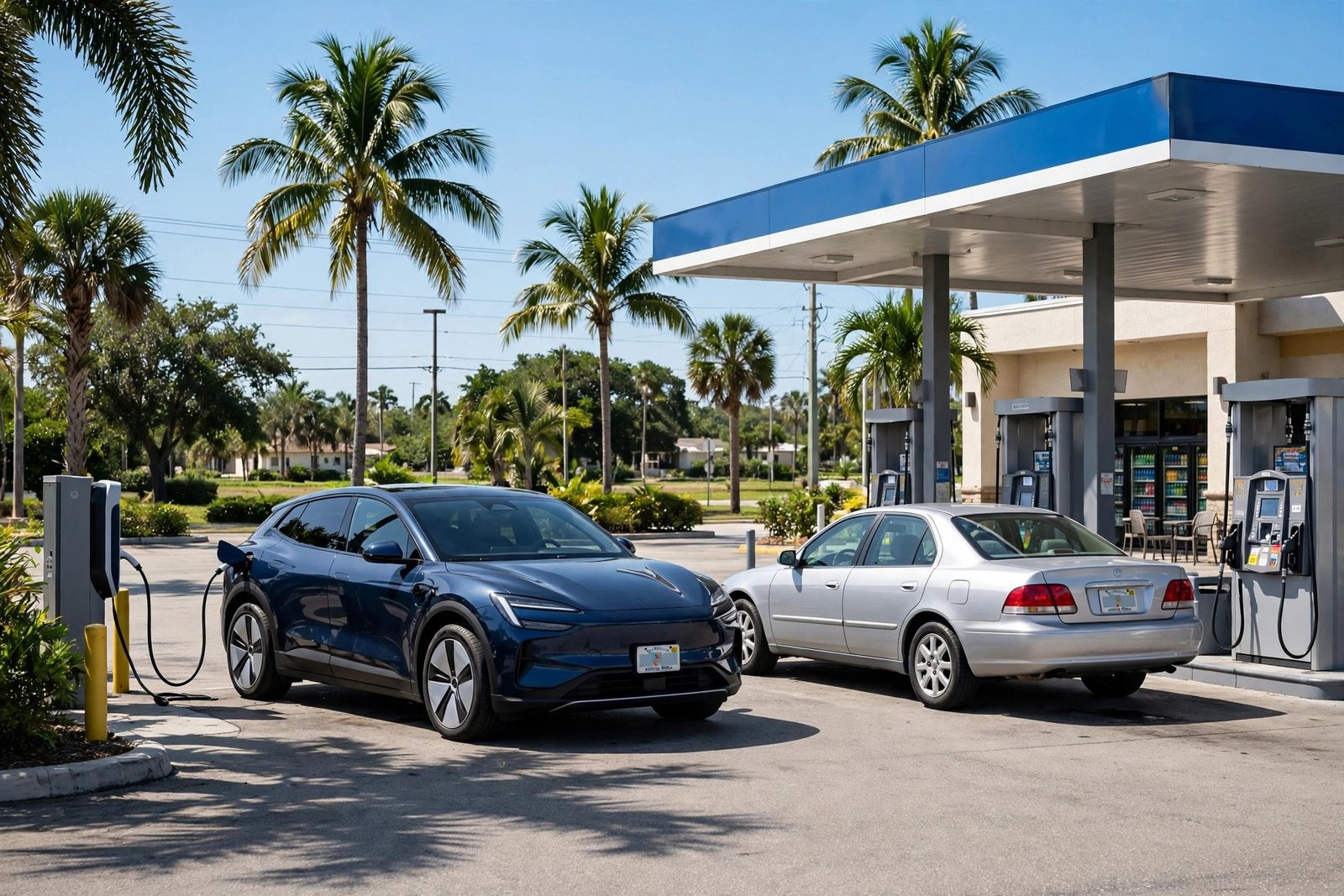
Floridians face the gas-versus-electric decision under unique conditions: brutal heat, hurricane evacuations, abundant sunshine, cheap-ish electricity, and zero state EV incentives. The national debate doesn’t quite apply here — and buyers who import generic advice make Florida-specific mistakes. Here are the biggest ones, from both directions: the errors gas loyalists make and the errors EV enthusiasts make.
Mistake 1: Comparing Sticker Prices Instead of Total Cost
The classic error, committed by both camps. EVs typically cost $5,000–$10,000+ more upfront than comparable gas cars — and gas cars cost $1,500–$2,500+ more annually in fuel and maintenance. Over 8 years/120,000 miles, the math often favors EVs for average drivers — but “often” isn’t “always.” Low-mileage drivers (under 8,000 miles/year) may never recoup the EV premium; high-mileage commuters recoup it fast.
Do YOUR math with fueleconomy.gov’s total-cost calculator: your mileage, your electricity rate, your gas prices, your insurance quotes (EVs can cost more to insure — get quotes before deciding). Anyone who decides on vibes or sticker price alone is guessing with $40,000.
Mistake 2: Ignoring Florida’s Heat Reality (Both Directions)
EV skeptics overstate it; EV fans understate it. Reality: Florida heat does accelerate battery degradation versus mild climates — but modern thermal management handles it well, and real-world data shows 10–15% degradation over 150,000+ miles, not the catastrophic failure skeptics predict. On the flip side, gas cars suffer too: heat kills 12V batteries, stresses cooling systems, and A/C running full-blast tanks gas mileage 10–25% in stop-and-go traffic.
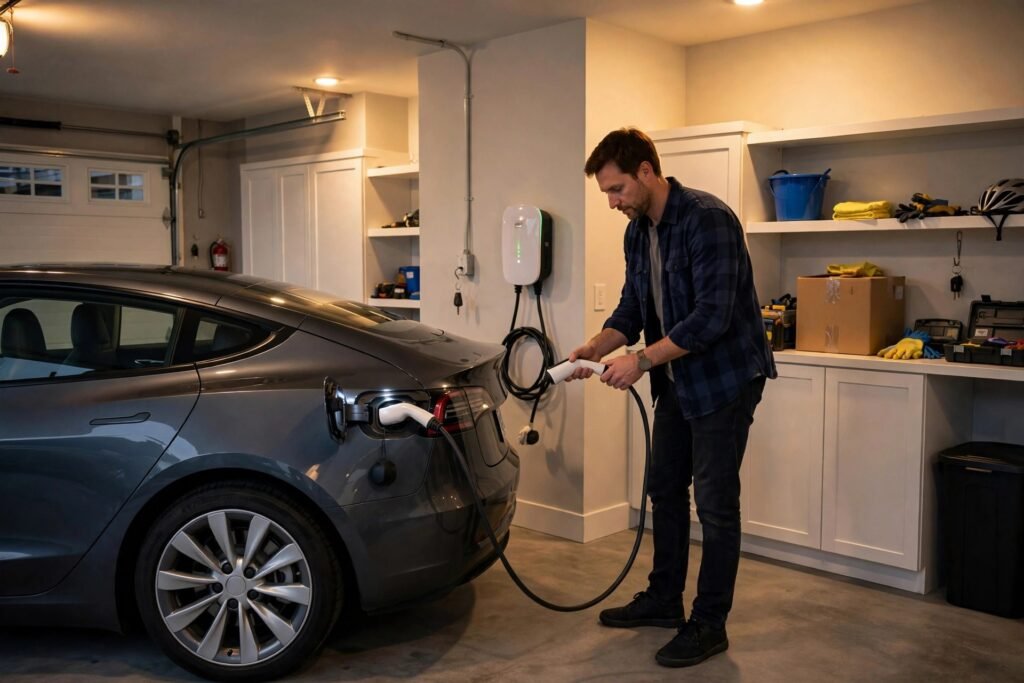
The Florida-specific EV consideration that matters: hurricane evacuation. Gas stations run dry in evacuations (fuel supply chains break); home-charged EVs leave with a “full tank” every morning — a genuine resilience advantage. But multi-day outages after the storm favor gas (generators, portable fuel) unless you have solar + battery. Neither powertrain wins hurricane season outright; know the trade-offs.
Mistake 3: Misjudging Charging (EV Buyers) and Ignoring It (Gas Buyers)
EV mistake: assuming public charging is fine as a primary strategy. It’s not — it’s 2–3x the cost of home charging and far less convenient. The EV value proposition collapses without home (or reliable workplace) charging. Apartment dwellers without charging access should think very carefully; the math and the lifestyle both suffer.
Gas mistake: assuming gas prices stay where they are. Florida gas prices are volatile — hurricane disruptions, refinery issues, and global markets swing them 50+ cents routinely. EV “fuel” costs (your electricity rate) are far more stable. When comparing, use conservative gas-price assumptions, not today’s pump price.
Mistake 4: Forgetting Insurance and Maintenance Asymmetries
EVs: higher insurance (expensive battery = expensive collision repairs, fewer qualified shops), much lower maintenance (no oil changes, fewer brake jobs thanks to regen, no transmission services). Gas: cheaper insurance, relentless maintenance schedule. Consumer Reports data shows EVs’ maintenance savings are real and substantial — roughly half the maintenance cost of gas cars — but insurance can erase a chunk of that. Get insurance quotes for BOTH options before deciding; it’s the most-skipped step in the comparison.
Apply the same value-verification discipline you’d use for any major tech purchase: total cost of ownership over your actual holding period, not feature lists or fuel-type tribalism.
Mistake 5: Deciding on Identity Instead of Use Case
The deepest mistake is tribal: “I’m a gas person” or “I’m an EV person.” The right answer is use-case driven. EV wins for: homeowners with garages, daily commuters with predictable routes, two-car households (one EV + one gas = best of both). Gas wins for: apartment dwellers without charging, frequent long-distance tower/haulers, low-mileage drivers, and buyers minimizing upfront cost. A Miamian with a garage and a 40-mile commute and a Floridian road-warrior salesperson have opposite correct answers — and both are rational.
And keep the home front efficient regardless of choice — reducing home energy costs amplifies EV savings and cushions gas-price volatility alike.
The Used EV Question Floridians Keep Asking
Used EVs are the market’s most interesting depreciation story — early models lost value brutally as technology advanced, creating genuine bargains. A 3-year-old EV at 55% of original price with 85%+ battery health is potentially the best value in car buying right now. But the battery-health variance between individual used EVs is enormous — it depends entirely on how the previous owner charged and where the car lived.
Non-negotiable used-EV checks: get a battery health report (dealer diagnostic or third-party services — demand the actual state-of-health percentage, not assurances), verify remaining battery warranty (8-year/100k-mile federal minimum — a 4-year-old car still has 4 years of battery coverage, which de-risks the purchase enormously), check the charging port type and compatibility, and review the car’s DC fast-charging history if available (heavy fast-charging = more degradation). Florida-specific: heat-aged batteries in always-outside-parked cars degrade faster — ask about parking history the way you’d ask about accident history. A garage-kept Florida EV and a sun-baked one are different cars wearing the same badge. Price the difference accordingly.
Depreciation Winners: The Models That Defy the Curve
While most cars follow the standard curve, a select group depreciates remarkably slowly — knowledge that’s pure profit whether buying new or used. The usual champions: Toyota Tacoma and 4Runner (body-on-frame trucks with cult followings routinely retain 70%+ after 3 years), Jeep Wrangler (lifestyle demand sustains values), Porsche 911 (the sports car that appreciates in some years), Honda Civic and Toyota Corolla (appliance-like demand), and Subaru Crosstrek/Forester (all-weather reputation).
Why they hold value: reputation for reliability (buyers pay premiums for certainty), constrained supply relative to demand (Tacomas sell themselves; dealers rarely discount), and enthusiast communities that sustain secondary markets. How to exploit it: buying these models new is less punishing than average (the depreciation “tax” is smaller); buying them used means paying closer to new prices — so run the new-vs-lightly-used math carefully, because the usual used discount shrinks. Conversely, the steepest depreciators (luxury flagships, discontinued models) are terrible new purchases but spectacular used buys. Depreciation isn’t uniform — it’s a model-specific landscape, and the map is published data.
Conclusion
Floridians deciding between gas and electric go wrong by comparing sticker prices instead of total ownership cost, misjudging heat impacts in both directions, ignoring charging logistics (EV) or fuel volatility (gas), skipping insurance quotes, and deciding tribally instead of by use case. Run your numbers — your mileage, your rates, your housing situation — and let the spreadsheet, not the tribe, choose. In Florida’s specific conditions, the right answer is personal, calculable, and often surprising.
Frequently Asked Questions
What are the biggest mistakes when deciding between gas and electric cars in Florida?
Comparing sticker prices instead of 8-year total cost, misjudging Florida heat effects, assuming public charging works as a primary strategy, skipping insurance quotes for both options, and choosing by identity rather than use case.
Are electric cars good in Florida heat?
Yes, with caveats — modern thermal management handles heat well, with typical degradation of 10–15% over 150,000+ miles. Home charging, shade parking, and 20–80% daily charging limits matter more in hot climates.
Is an EV cheaper than a gas car overall?
Often yes for average-to-high-mileage drivers with home charging — lower “fuel” and maintenance costs overcome the higher purchase price over 6–10 years. Low-mileage drivers may not break even. Calculate with your specific numbers.
What about hurricane evacuation with an EV?
Home-charged EVs evacuate with a full “tank” daily — an advantage when gas stations run dry. But extended post-storm outages favor gas unless you have solar + battery backup. Neither is perfect; plan for your scenario.
Can I own an EV in Florida without home charging?
It’s difficult — public charging costs 2–3x home rates and adds major inconvenience. Apartment dwellers should verify reliable workplace or nearby charging before committing; otherwise gas usually wins on practicality.