Eight thousand dollars doesn’t buy much car in 2026 — or does it? The used market under $8K is where the sharpest buyers operate, because it’s the price band where knowledge beats money. A well-chosen $6,500 Honda with 110,000 miles will reliably outlast a $7,900 luxury badge with a troubled past. The difference between a bargain and a money pit isn’t luck; it’s a repeatable inspection process anyone can learn.
So do you need a professional’s help? Not necessarily — but you need a professional’s checklist. This guide gives you exactly that: which cars to target, how to inspect like a mechanic, the history checks that expose hidden damage, and the specific moments when paying a pro $150 for a pre-purchase inspection is the smartest money you’ll spend.
Target the Right Cars: Reliability Is a Model, Not a Brand
Under $8,000, you’re shopping roughly 2008–2016 model years with 80,000–140,000 miles. The winners in this band are famously boring: Honda Civic/Cr-V, Toyota Corolla/Camry/RAV4, Mazda3, and certain Hyundai/Kia models (2012+). These have cheap parts, simple engineering, and enormous owner communities documenting every common failure. Avoid at this price: German luxury (repair costs don’t depreciate with the car), continuously-variable-transmission Nissans of certain years (transmission failures are endemic), and anything with a salvage title unless you deeply know what you’re doing.
Set your filters ruthlessly: private sellers and reputable independents over curbside flippers, maintenance records over low miles (a 130,000-mile car with full service history beats a 90,000-mile mystery), and southern cars over northern ones — Florida cars dodge the rust that kills Midwestern vehicles, a genuine regional advantage. Check the National Highway Traffic Safety Administration’s recall database for any candidate — outstanding safety recalls are free to fix at dealers and reveal how the car was maintained.
The History Check: Your $25 Force Field
Before you even test-drive, run the VIN. Paid reports (CARFAX, AutoCheck, ~$25–$40 for a single report) reveal accidents, title brands (salvage, flood, lemon), odometer rollbacks, service history, and ownership counts. In Florida, flood history is the critical check — hurricane-damaged cars get laundered through title washing, and a flood car is a rolling electrical nightmare. The National Insurance Crime Bureau’s free VINCheck catches insurance-declared total losses and thefts at no cost — run it on every candidate.
Read reports skeptically: clean reports don’t guarantee clean cars (not all accidents get reported), but dirty reports are disqualifying. Multiple owners in short spans, registration gaps, or mileage inconsistencies are walk-away signals. And verify the VIN on the report matches the VIN plate on the dashboard and door jamb — mismatches mean walk away immediately. When shopping online listings, apply the same caution you’d use anywhere: checking whether a site is safe to shop on keeps you clear of the curbstoner scams that infest budget car listings.
Inspect Like a Mechanic: The 30-Minute Walkaround
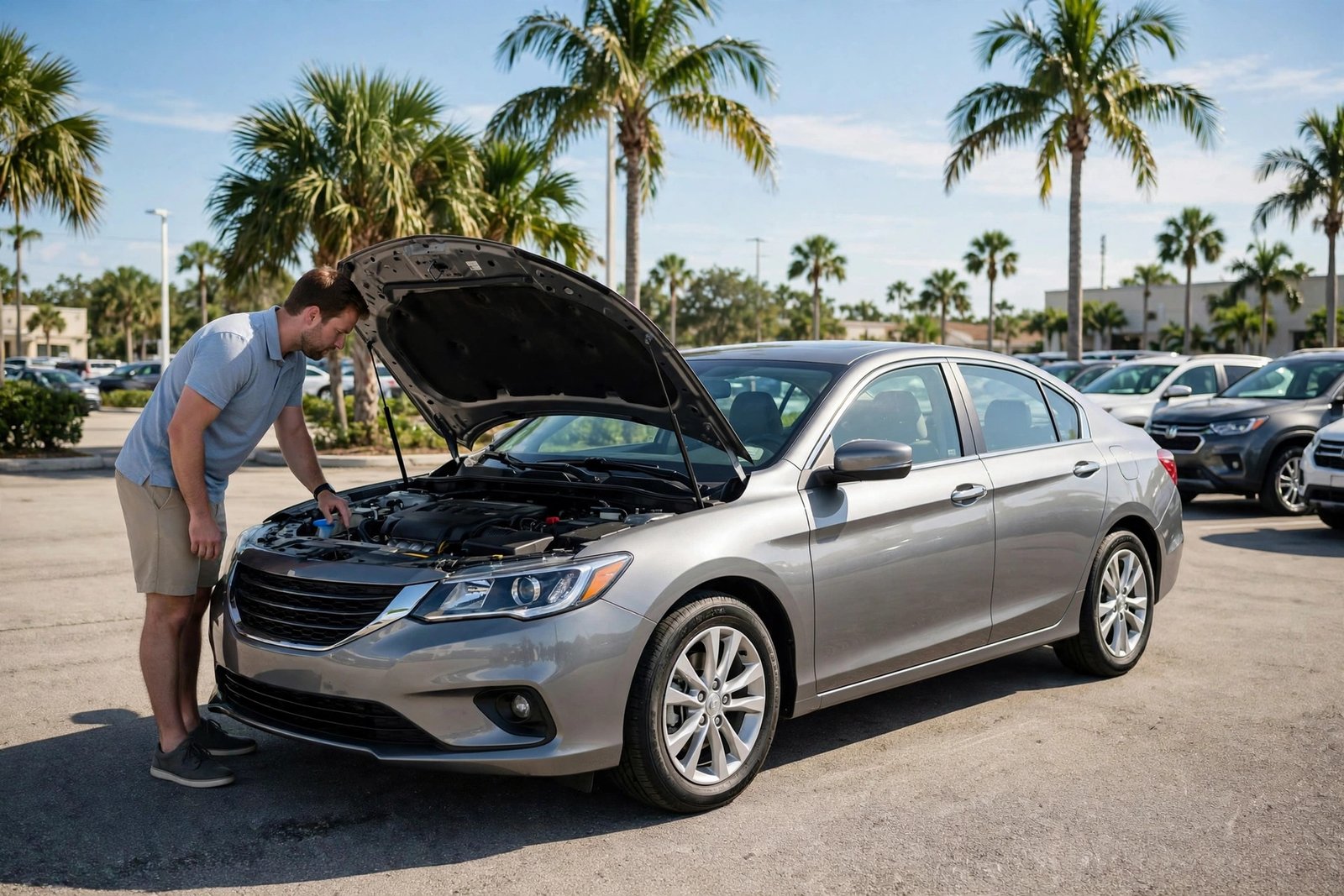
Do this in daylight, on every candidate, before any negotiation. Exterior: mismatched paint or panel gaps signal accident repair; run a magnet over steel panels (bondo doesn’t attract); check tire wear patterns (uneven wear = alignment/suspension issues); look under the car for leaks and rust. Under the hood (cold engine): oil should be amber-brown, not milky (milky = head gasket failure, walk away) or gritty; coolant should be clean, not rusty or oily; belts and hoses shouldn’t be cracked. Interior: musty smell plus damp carpets = flood or leak history; every button, switch, and light should work — electrical gremlins are expensive.
Test drive (20+ minutes): cold start (listen for knocks, smoke), highway speed (vibrations, pulling), hard braking (pulsing = warped rotors), full-lock turns (clicking = CV joints), and every gear including reverse. Turn the radio off and listen — the car is telling you everything. This process mirrors professional diligence in any used purchase; the same inspect-before-you-trust instinct behind checking whether a used phone is worth buying applies double to a machine with 2,000 moving parts.
When to Pay a Pro (and How to Negotiate)
Get a pre-purchase inspection (PPI) — $120–$180 at an independent shop — for any car you’re serious about. The mechanic puts it on a lift, scans for codes, and finds what your walkaround can’t: seeping gaskets, worn bushings, pending transmission issues. This is the highest-ROI $150 in car buying; it either confirms your pick or saves you from a $3,000 mistake. Always use your own mechanic, never the seller’s.
Negotiate with the PPI report in hand: every defect found is a discount argument, quoted in repair dollars. Private sellers in the sub-$8K market typically have 10–15% negotiation room; dealers less, but their cars should need less work. Know the FTC’s Used Car Rule — dealers must display a Buyers Guide disclosing warranty status, and “as-is” means exactly that. Final steps: verify the title is clean and in the seller’s name, complete the bill of sale with VIN/price/signatures, and handle Florida title transfer and registration promptly — driving on someone else’s plates is never worth the risk.
Budget the Real Cost: Purchase Price Is Just the Start
Your $8,000 budget isn’t $8,000 for the car — it’s roughly $6,800 for the car plus $1,200 for taxes, title, registration, insurance down payment, and immediate maintenance (tires, brakes, fluids — budget $500–$800 for catch-up maintenance on any used car). Insurance for older cars: get quotes before buying, and consider liability-only on a sub-$8K vehicle — full coverage often costs more than the car’s value over a few years. And keep a $1,000 repair reserve; even the best $7,000 car is still a used machine.
For getting around while you shop — or if you decide to delay the purchase — the cheapest ways to travel between US cities can bridge the gap without rental-car bleeding.
Conclusion
Buying a reliable used car under $8,000 without a professional’s help is entirely doable: target boring-reliable models with service history, run VIN and flood checks on every candidate, perform the 30-minute inspection walkaround, and pay $150 for a pre-purchase inspection before money changes hands. You don’t need a mechanic in your family — you need a mechanic’s checklist and the discipline to walk away from cars that fail it. Do that, and $8,000 buys years of dependable transportation.
Frequently Asked Questions
What’s the most reliable used car under $8,000?
Honda Civic/Corolla-class compacts (Civic, Corolla, Mazda3) from 2010–2015 with documented maintenance are the safest bets — cheap parts, simple mechanics, and proven 200,000-mile longevity. Condition and history matter more than the badge.
How many miles is too many for a used car?
There’s no magic number — a maintained 140,000-mile Toyota beats a neglected 80,000-mile anything. Focus on service records, current condition, and model-specific longevity rather than the odometer alone.
Should I buy from a dealer or private seller?
Private sellers usually offer better prices and more honest history; dealers offer convenience and (sometimes) short warranties. In the sub-$8K market, a well-vetted private seller with records is often the better deal — with a PPI either way.
Is a pre-purchase inspection really worth $150?
Yes — it’s the best money in car buying. It catches hidden problems (leaks, worn suspension, pending transmission issues) that cost thousands, and the report doubles as negotiation leverage. Skip it only if you can afford to lose the purchase price.