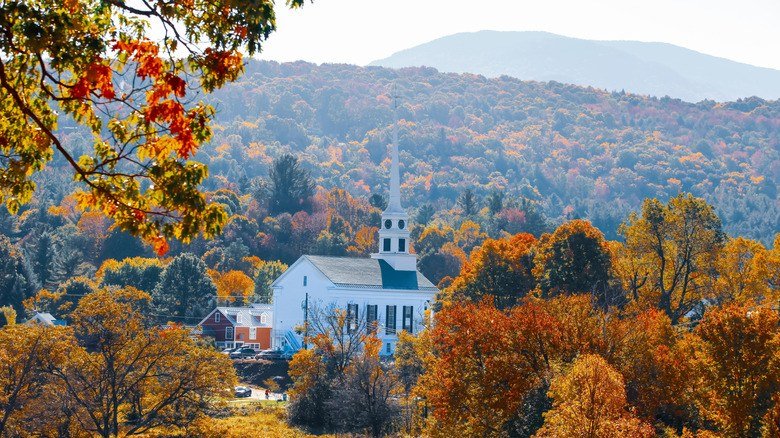
New England’s small towns are America’s storybook come to life — white-steepled churches, general stores with creaky floors, maple syrup operations, harbors full of working boats. But with hundreds of postcard towns across six states, which ones are actually worth the detour? Here are the best small towns to visit in New England, chosen for distinct character rather than generic charm — each one offers something you can’t get elsewhere.
Vermont: The Pastoral Icons
Woodstock
The platonic ideal of a Vermont town: village green, covered bridges nearby, the Marsh-Billings-Rockefeller estate, and a main street that looks preserved in amber (in the best way). It’s slightly polished, but the surrounding countryside — especially in fall — is transcendent. Go in October for foliage at its peak, or in quieter seasons for the town without crowds.
Stowe
Yes, it’s a ski town, but summer/fall Stowe is the better visit: the auto toll road up Mt. Mansfield, the 5.3-mile recreation path for biking, and the Trapp Family Lodge (yes, those Trapps) with its mountain views and brewery. It’s pricier than other Vermont towns, but the scenery-to-effort ratio is unmatched.
New Hampshire & Maine: Mountains and Coast
North Conway, New Hampshire
Gateway to the White Mountains with a wonderfully preserved 19th-century main street. The Conway Scenic Railroad, outlet shopping (if that’s your thing), and trailheads in every direction. It’s the adventure base camp — hike in the morning, stroll the town in the afternoon. Fall foliage here rivals anywhere in New England.
Camden, Maine
“Where the mountains meet the sea” — Camden Hills rising directly behind a working harbor full of windjammers. Take a sailing trip on a historic schooner, hike Mt. Battie for the panoramic view, eat lobster on the waterfront. It’s the Maine coast fantasy made real, without Bar Harbor’s summer crush (though book ahead regardless).
Kennebunkport, Maine
Upscale coastal charm: boutique shops, art galleries, gorgeous beaches (Goose Rocks is the local favorite), and a food scene punching above its weight. It’s the refined Maine experience — pricier, polished, and perfect for a romantic getaway or a slow weekend of walking and eating well.
What Are the Best Small Towns to Visit in New England for History?
Stockbridge, Massachusetts
Norman Rockwell’s hometown, and it shows — Main Street looks like his paintings because it was his paintings. The Rockwell Museum is genuinely moving even if you’re not an art person, and the surrounding Berkshires offer Tanglewood concerts in summer and world-class fall color. It’s nostalgia you can walk through.
Mystic, Connecticut
The seaport town with the working maritime museum (climb aboard historic ships), the famous aquarium, and a drawbridge downtown that still opens for boats. It’s family-friendly without being kitschy, and the coastal Connecticut food scene — lobster rolls, oyster bars — is excellent.
Newport, Rhode Island
Technically a small city, but it feels like a town: Gilded Age mansions (The Breakers will drop your jaw), the Cliff Walk combining ocean views with mansion views, and a harbor full of sailboats. The mansions are the draw, but the town itself — Thames Street’s shops and restaurants — rewards wandering.
Planning the Trip
- When: Fall foliage (late September-October, peak moving north to south) is the headline, but summer brings the coast alive and winter brings skiing and cozy inns. Spring is mud season — pretty, but quiet.
- How long: Each town deserves 1-2 days. String 3-4 together for a perfect week — Vermont loop, Maine coast, or Berkshires-to-Berkshires.
- Where to stay: Inns and B&Bs are the New England way — often cheaper than hotels and infinitely more characterful. Book fall weekends months ahead; they’re the region’s Super Bowl.
- What to eat: Lobster rolls (hot with butter in Connecticut, cold with mayo in Maine — know the rivalry), maple everything in Vermont, clam chowder everywhere, apple cider donuts at farm stands in fall.
Combine with our weekend getaway planning guide for the logistics, and check the regional tourism resources for foliage trackers and seasonal events. New England’s small towns aren’t just pretty — they’re the living version of an America that’s increasingly hard to find. Go slowly, talk to shopkeepers, and let the towns set the pace.
The Fall Foliage Pilgrimage: Timing It Right
New England fall color is the region’s Super Bowl — spectacular, crowded, and timing-critical. The progression: peak color moves south over about six weeks — northern Vermont/New Hampshire/Maine in late September, central areas early-mid October, southern New England and the coast mid-late October. Higher elevations and inland areas peak before valleys and coasts.
Tracking it: state tourism sites publish foliage trackers updated weekly — check them, don’t guess. A week early means green; a week late means brown. Beating crowds: go midweek (weekend traffic on foliage routes is legendary), start drives at sunrise (the light is better anyway), and explore back roads — the famous routes (Kancamagus Highway, Route 100) are stunning but packed; parallel roads offer 90% of the color with 10% of the cars.
Where to base: pick one town and do day trips rather than hotel-hopping — unpacking once beats living from a suitcase. Book lodging 3-6 months ahead for peak weekends; they’re the hardest reservations in New England travel. And build in non-foliage activities (farm stands, cider mills, covered bridges, small museums) — the color is the headline, but the towns are the story. Peak week visitors see red and orange; smart visitors see all of it.
The General Store Rule
Every great New England small town has a general store — and it’s the fastest way to read a town’s character. The good ones have creaky floors, penny candy, local maple syrup, a bulletin board full of community notices, and someone behind the counter who’ll tell you where the locals eat. Make it your first stop in every town: grab coffee, read the bulletin board (yard sales, concerts, suppers — the real event calendar), and ask for one recommendation. The general store is the town’s living room, and ten minutes there orients you better than any guidebook.
Small towns make perfect weekend escapes — our weekend getaway playbook covers the logistics, and budget road trip planning works for stringing several together.