Lower back pain has a way of hijacking your whole day. You bend to tie your shoes and freeze. You sit through a meeting and stand up like you’re 90. I’ve been there — after a long stretch of desk work, my lower back staged a full protest, and the only thing that genuinely helped wasn’t a fancy gadget. It was ten minutes of simple stretching, done consistently.
So what are the best stretches for lower back pain? The honest answer: the gentle ones that target your hips, hamstrings, and the muscles hugging your spine — not aggressive back-bending. Here’s what actually works, why it works, and the stretches to skip.
First, a quick reality check
Stretching helps muscular back pain — the stiff, achy kind from sitting, sleeping wrong, or overdoing yard work. It does not fix everything. If your pain shoots down your leg, comes with numbness or weakness, follows an injury, or hasn’t improved in a couple of weeks, see a doctor or physical therapist instead of stretching through it. The National Institute of Arthritis and Musculoskeletal and Skin Diseases notes that most acute back pain improves within days to weeks, but red-flag symptoms deserve professional eyes.
What are the best stretches for lower back pain? The seven that matter most
Do these slowly, breathing deeply. Never bounce, and never push into sharp pain — a gentle pull is the target.
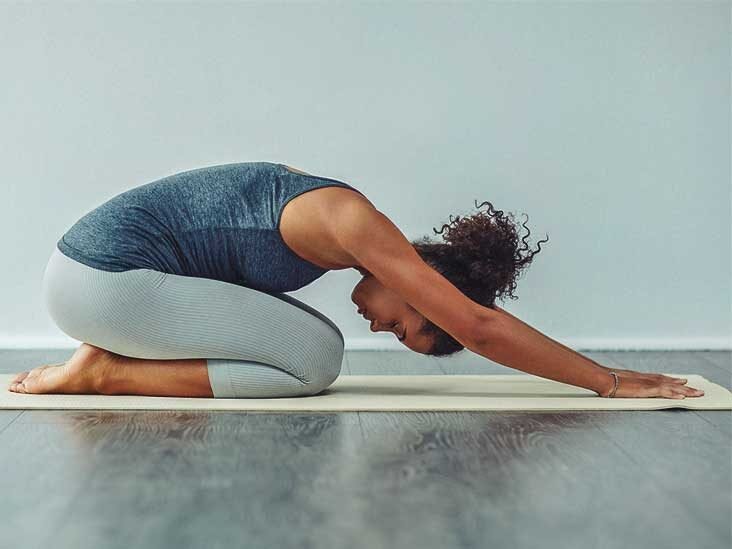
1. Child’s pose (the reset button)
Kneel, sit your hips back toward your heels, and walk your hands forward until your forehead rests on the floor. Hold 30–60 seconds. This gently lengthens the lower back muscles and feels like a sigh of relief in pose form.
2. Knee-to-chest (single and double)
Lie on your back, pull one knee toward your chest, hold 20–30 seconds, then switch. Finish by hugging both knees in. This decompresses the lumbar spine and loosens the hip flexors that tug your pelvis forward when you sit all day.
3. Supine twist
Lying on your back with arms out in a T, drop both bent knees to one side while keeping shoulders down. Hold 30 seconds per side. This wrings out the obliques and the small rotator muscles along the spine — the ones that seize up after long drives.
4. Cat-cow
On all fours, slowly arch your back then round it, syncing with your breath. Ten slow rounds. This is less a “stretch” and more a mobility drill — it gets blood flowing to stiff spinal segments.
5. Figure-four (piriformis) stretch
Lie on your back, cross your right ankle over your left knee, and gently pull the left thigh toward you. That deep buttock muscle — the piriformis — refers pain into the lower back when it’s tight, and desk workers almost all have tight piriformis muscles.
6. Standing hamstring stretch
Prop one heel on a low step, hinge at the hips with a flat back until you feel the pull behind your thigh. Tight hamstrings pull the pelvis into a tilt that loads the lower back — this one addresses the root cause, not just the symptom.
7. Sphinx pose (gentle extension)
Lie face-down, prop up on your forearms, and let your back sag gently into a mild arch. Hold 30 seconds. For disc-related achiness, gentle extension often feels better than forward bending — but skip it if it increases leg pain.
When and how often to stretch
Once a day beats a heroic 45-minute session once a week. Morning is ideal — backs are stiffest after sleep — but an evening routine works too. Pair it with a short morning stretching routine and you’ve got a two-minute upgrade to your whole day. Consistency for two weeks is when most people notice the morning stiffness fading.
The stretches to avoid with back pain
Skip aggressive toe touches with rounded backs, deep backbends, and loaded twisting while you’re in pain. The old-school sit-up is also out — it loads spinal discs heavily. If a stretch sends pain down your leg or makes things worse the next morning, drop it from the routine.
Strengthen what you stretch
Pair these stretches with home strength training focused on the core, glutes, and back — stretching relieves the pain, but strength prevents its return. The combination is what physical therapists prescribe; either alone is half the solution.
The takeaway
The best stretches for lower back pain aren’t exotic — they’re the boring, gentle classics: child’s pose, knee-to-chest, supine twists, cat-cow, figure-four, hamstring stretches, and mild extension. Do them daily, move more during the day (your back hates the chair more than anything), and get checked out if pain persists or radiates. Your back carried you this far — ten minutes of stretching is a fair trade.
Stretching helps — strengthening fixes: the long-term play
Here’s what physical therapists wish more people knew: stretching relieves back pain, but strengthening prevents it from coming back. The stretches above calm things down; these exercises keep them calm. The two that matter most are dead bugs (lie on your back, extend opposite arm and leg slowly — brutal for deep core stability) and bird dogs (on all fours, extend opposite arm and leg — trains the spinal stabilizers). Add glute bridges for the posterior chain and side planks for the obliques, and you’ve covered the entire support system of the lumbar spine.
Two 15-minute sessions a week is enough to start. The research on core strengthening for back pain prevention is strong — people who maintain basic core strength have significantly fewer recurrent episodes. Think of it as insurance: stretching is the claim you file when pain shows up; strengthening is the premium that keeps claims rare. Start the stretches today for relief, add the strengthening this week for the future, and your back gets both immediate comfort and long-term resilience.
The desk worker’s hourly micro-break
Stretching once a day helps; interrupting the sitting that causes the pain helps more. Set an hourly reminder: stand, roll your shoulders, do 5 cat-cow stretches (standing version: hands on knees, arch and round), walk for 60 seconds. It takes 90 seconds and prevents the 8-hour stiffness accumulation that no evening stretch fully undoes. The research on “movement snacks” is compelling — frequent short breaks beat one long session for musculoskeletal pain. Your back doesn’t need a workout; it needs to not be frozen in a chair all day.