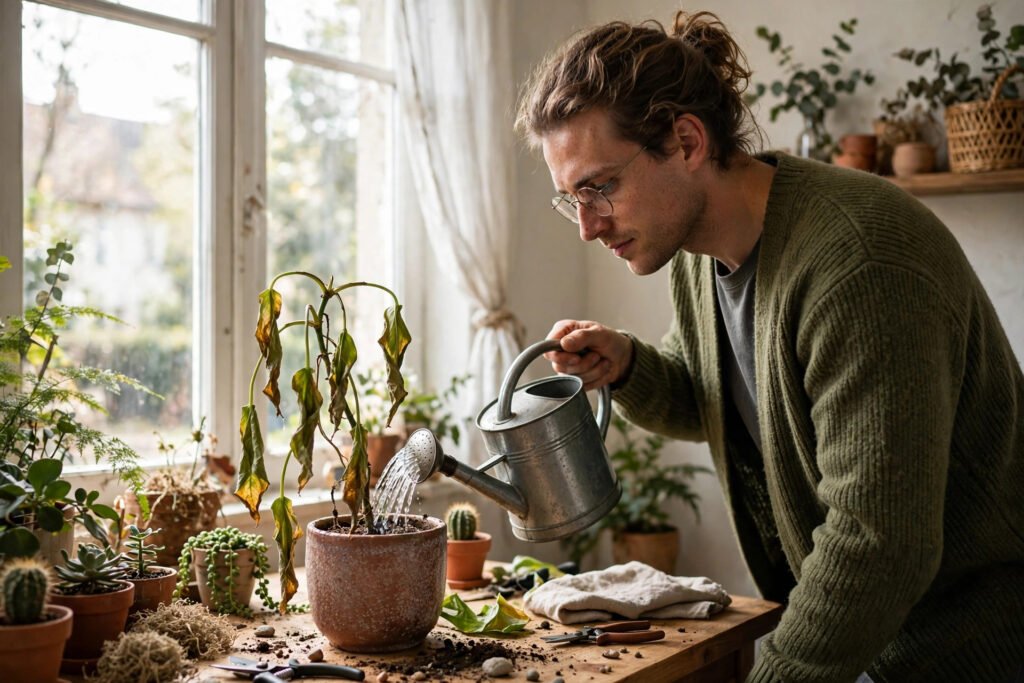
Your houseplant was thriving. Then the leaves started yellowing, then drooping, then — despite your increasingly desperate interventions — it looks like it’s auditioning for a Halloween decoration. So you do what every panicking plant owner does: water it more, move it around, mist it, repot it, fertilize it, talk to it. And it gets worse. Here’s the painful truth about dying houseplants: most of them aren’t killed by neglect. They’re killed by the rescue attempt.
When people try to save a dying houseplant step by step, they make predictable mistakes that finish off a plant that might have recovered. Here are the biggest ones — and what to do instead.
Mistake 1: Watering on a Schedule Instead of Checking the Soil
“Water every Tuesday” is the most common plant-killing advice in existence. Plants don’t drink on schedules; they drink based on light, temperature, humidity, pot size, and season. A plant in a bright Florida window in July needs water twice as often as the same plant in a dim corner in January.
The fix is embarrassingly simple: stick your finger two inches into the soil. Dry? Water thoroughly until it drains from the bottom. Still moist? Walk away. For most houseplants, this single habit prevents more deaths than any fertilizer or gadget. Moisture meters ($10) work too, but your finger is free and never needs batteries.
Mistake 2: The Panic Overwatering Spiral
This is the number-one houseplant killer, and it works like this: leaves droop → owner assumes thirst → waters → leaves droop more (because roots are now drowning) → owner waters again → roots rot → plant dies. Drooping leaves signal root problems, and overwatering causes far more root problems than underwatering.
Before watering a drooping plant, check the soil. If it’s wet and the plant is drooping, water is the problem, not the solution. Let it dry out, ensure the pot has drainage holes (non-negotiable — decorative pots without drainage are plant coffins), and only water when the top inches dry. Yellow, mushy leaves plus wet soil equals overwatering; dry, crispy leaf edges plus dry soil equals underwatering. Learn to read these signs and you’ll diagnose correctly nine times out of ten.
Mistake 3: Repotting as First Aid
A struggling plant does not need the trauma of repotting. Yet it’s many owners’ first instinct — as if new soil will cure everything. Repotting damages the fine root hairs that absorb water, exactly when the plant can least afford it. It’s surgery on a patient that needed rest.
Repot only when: roots are visibly circling out of drainage holes, water runs straight through without absorbing (severely root-bound), or the soil is contaminated. Otherwise, leave the plant alone. If you suspect the soil is the issue, top-dressing (adding fresh soil on top) gives benefits without the shock.
Mistake 4: Fertilizing a Stressed Plant
Fertilizer is plant food, and the logic feels sound: sick plant + food = recovery. But fertilizer is actually salts, and a stressed plant with damaged roots can’t process them — the salts accumulate and burn the already-struggling roots. It’s like force-feeding someone with food poisoning.
Rule: never fertilize a plant in crisis. Wait until you see new growth — that’s the plant telling you its roots work again. Then fertilize at half strength. Most houseplants need feeding only during spring and summer growing seasons anyway; fertilizing a dormant winter plant is wasted money at best.
Mistake 5: Moving It Around Constantly
Plants acclimate to their spot — light direction, humidity, airflow. Every move forces re-acclimation, costing energy the plant doesn’t have. The well-meaning shuffle (bathroom for humidity! window for light! away from the AC!) stresses an already-weak plant further.
Pick the best available spot and commit for at least a month. For most houseplants, that’s bright indirect light — near a window but out of direct Florida sun, which scorches leaves through glass surprisingly fast. If you started with the easiest indoor plants for beginners, they’re more forgiving of imperfect placement — another reason beginners should start there.
Mistake 6: Misting Instead of Addressing Humidity
Misting feels nurturing, but its effect lasts about five minutes before the water evaporates — and wet leaves in still indoor air invite fungal problems. If your plant genuinely needs humidity (calatheas, ferns, many tropicals — common in Florida homes ironically, where outdoor humidity is high but AC makes indoor air desert-dry), misting won’t cut it.
What works: grouping plants together (they humidify each other), a pebble tray with water under the pot, or a small humidifier nearby. These raise ambient humidity for hours, not minutes. NASA’s famous clean air study explored houseplants and indoor environments, and UF’s IFAS Extension publishes research-backed houseplant care guides specifically for Florida conditions. And know your plant — a snake plant doesn’t want humidity at all, and misting it just risks rot.
Mistake 7: Ignoring Pests Until It’s an Infestation
By the time webbing, sticky residue, or visible bugs appear, you’re fighting an entrenched population. Beginners should inspect new plants before buying (check leaf undersides and soil) and glance at existing plants weekly during watering. Early-caught spider mites, mealybugs, and fungus gnats are trivially treatable with neem oil, insecticidal soap, or simply wiping leaves. Late-caught infestations can kill.
Quarantine new plants for two weeks before placing them near your collection. This single habit prevents most pest disasters.
The Actual Step-by-Step Rescue (What Works)
When a plant is declining, do this — in this order, and nothing else for two weeks:
- Diagnose: check soil moisture, look at leaf symptoms (yellow-mushy vs. brown-crispy), inspect for pests, recall recent changes.
- Fix the likely cause only: overwatered? Let it dry and improve drainage. Underwatered? Water deeply. Pests? Treat. Light wrong? Move once.
- Prune dead material: remove fully dead leaves (yellow/brown and crispy) so the plant stops wasting energy on them. Don’t cut partially-green leaves — they’re still photosynthesizing.
- Wait. Two weeks minimum. Plants recover slowly; fussing daily helps you, not the plant.
Also match the plant to your conditions honestly — plants suited for low-light apartments will always outperform sun-lovers in a dark corner, no matter how much you intervene.
Conclusion
The biggest mistakes when saving a dying houseplant all share a root cause: doing too much, too fast. Overwatering, panic repotting, fertilizing stress, constant moving, and misting theater all feel like help but function as harm. The plants that recover are the ones whose owners diagnose carefully, change one variable, and then wait. Less intervention, more observation — that’s the whole secret. Your plant doesn’t need a hero. It needs a detective with patience.
Frequently Asked Questions
Can a dying houseplant be saved?
Often yes, if the roots are still alive. Check by gently inspecting: firm, whitish roots mean recovery is possible; black, mushy, foul-smelling roots mean rot has won. Even severely declined plants can rebound from healthy roots.
Should I repot a dying plant?
Usually no — repotting adds transplant shock to existing stress. Only repot if the plant is severely root-bound or the soil is contaminated. Otherwise, fix the actual problem first.
Why are my plant’s leaves turning yellow?
Yellow, mushy leaves with wet soil indicate overwatering; yellowing with dry soil suggests underwatering or nutrient deficiency. Check soil moisture first — it’s the cause nine times out of ten.
How long does it take a plant to recover?
Weeks to months. New growth is the sign of recovery — wait for it before fertilizing or declaring victory. Plants operate on their own timeline, not yours.
Is misting good for houseplants?
Minimally — the humidity boost lasts minutes. For plants needing real humidity, use pebble trays, grouping, or a humidifier instead. Some plants (succulents, snake plants) shouldn’t be misted at all.