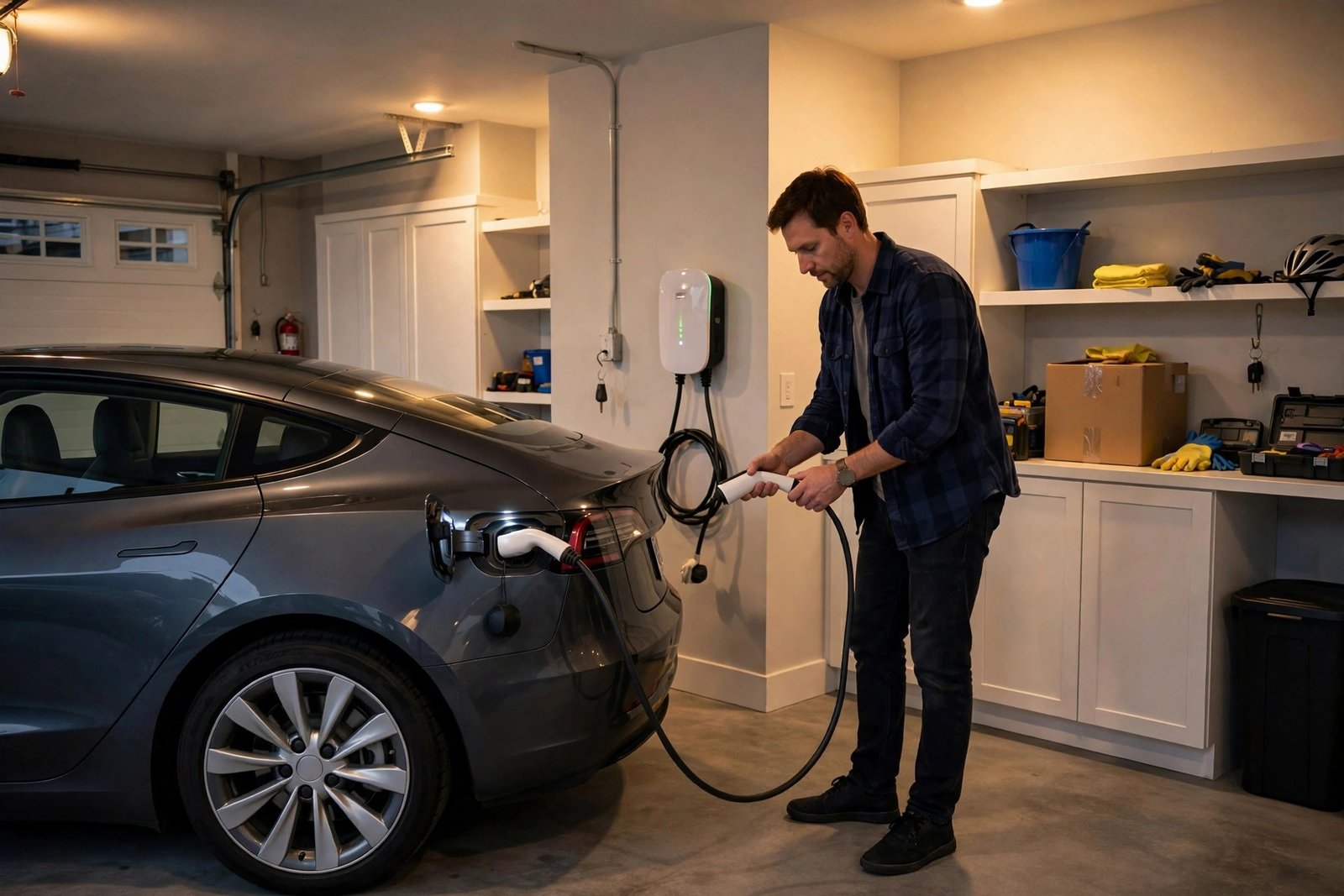
“How much does it cost to charge an EV at home?” sounds like a simple question with a simple answer. It isn’t — the real number depends on your electricity rate, your car’s efficiency, how much you drive, and whether you install a Level 2 charger. But the math is very learnable, and for most Florida drivers the answer is pleasantly surprising: home charging typically costs a third to a quarter of gasoline. Here’s how to understand — and calculate — your exact EV charging costs at home.
The Core Formula: It’s Just Multiplication
Cost per charge = battery usable capacity (kWh) × your electricity rate ($/kWh). A Tesla Model 3 Long Range (~75 kWh usable) on Florida’s average residential rate (~$0.13–0.16/kWh) costs roughly $10–$12 for a full charge delivering ~340 miles. Per mile: about 3–4 cents. Compare a 30-mpg gas car at $3.20/gallon: ~11 cents per mile. Home charging wins by roughly 3x — before you even factor in cheaper maintenance.
The more useful formula is monthly: (miles driven monthly ÷ car’s miles-per-kWh) × your rate. Drive 1,000 miles/month in a car getting 3.5 miles/kWh at $0.14/kWh: 286 kWh × $0.14 = $40/month. That’s the number to compare against your current gas spending. The fueleconomy.gov calculator lets you run this comparison for specific models with your local rates.
Your Electricity Rate: The Biggest Variable
Florida residential rates vary by utility (FPL, Duke Energy, TECO) and rate plan. Two things to check: your actual per-kWh rate (find it on your bill — divide total charges by kWh used for the all-in number, since fixed fees distort the headline rate), and time-of-use options (many Florida utilities offer cheaper overnight rates — perfect for EV charging while you sleep, often cutting charging costs 30–50%).
Calling your utility to ask about EV rate plans takes ten minutes and is the highest-ROI phone call in EV ownership. Some utilities also offer EV charger rebates — free money for equipment you’d buy anyway. Pair this with broader home energy efficiency upgrades — an EV adds 300–500 kWh/month to household use, and efficiency elsewhere keeps the total bill civilized.
Level 1 vs. Level 2: The Equipment Math
Level 1 (standard 120V outlet): free (you own outlets), adds 3–5 miles of range per hour. Fine if you drive under ~40 miles daily and charge overnight. Level 2 (240V, professionally installed): $500–$2,000 installed depending on panel capacity and wiring distance, adds 25–40 miles per hour. Worth it for: daily drivers over 50 miles, households with two EVs, or anyone who values full charges overnight.
The payback math: if Level 2’s convenience lets you fully exploit cheap overnight rates versus daytime top-ups, or if it replaces any public charging ($0.30–$0.50+/kWh — 3x home rates), the $1,200ish install pays back surprisingly fast. The Department of Energy notes home charging remains the cheapest per-kWh option by wide margins — every public-charging session you avoid through adequate home equipment is money saved.
The Hidden Costs (Small, But Know Them)
Charging isn’t 100% efficient — expect 10–15% energy loss (heat, conversion), so budget slightly above the battery math. Cold snaps (rare in Florida, but they happen) temporarily reduce efficiency. Battery preconditioning in extreme heat draws extra energy. And if your electrical panel needs upgrading for Level 2 (older homes with 100-amp service), that’s $1,500–$3,000 — get an electrician’s assessment before buying the charger, not after.
Think of charging economics like any battery economics — the principles behind maximizing battery value scale up: charge smart (off-peak), avoid waste (public charging premiums), and maintain the system.
Workplace Charging: The Overlooked Second Option
Home charging gets all the attention, but workplace charging is the silent game-changer — especially for the two groups home charging doesn’t serve: apartment dwellers and high-mileage drivers. If your employer offers it (or could be persuaded), workplace Level 2 charging effectively doubles your charging access at what is often free or subsidized rates. Many Florida employers — particularly larger companies, hospitals, universities, and government offices — have installed chargers as employee perks; a surprising number of EV owners never think to ask.
Making the case to your employer: frame it as retention and sustainability — the IRS allows tax-advantaged treatment for employer-provided charging, Florida utilities offer commercial EV programs, and the installation cost ($3,000–$7,000 per port) is trivial against employee satisfaction. Employee petitions work: gather interested coworkers, present the business case to facilities, and offer to help research utility rebates. Workplace charging etiquette: move your car when charged (don’t camp the spot all day), use scheduling apps if provided, and never unplug others. For apartment-dwelling EV owners, a workplace charger transforms the ownership equation from “difficult” to “easy” — it’s worth changing jobs over, only half-jokingly.
The Solar + EV Combination: Florida’s Killer App
Florida’s sunshine makes the solar-plus-EV combination the state’s best energy deal — and the math keeps improving. A typical 8kW rooftop solar system in Florida generates ~12,000 kWh/year; a typical EV consumes ~3,500–4,500 kWh/year. Translation: a modest solar array powers your home AND your car, with surplus — effectively driving on sunshine at a levelized cost of $0.06–$0.08/kWh, half of grid rates.
The numbers: at $0.07/kWh solar cost versus $0.14 grid, an EV driving 12,000 miles/year saves an additional ~$250/year in “fuel” on top of solar’s home-electricity savings. Net metering in Florida (currently favorable, though policies evolve — verify current rules before investing) lets daytime solar surplus offset nighttime charging. The resilience bonus: solar + battery + EV is a hurricane-season power station — the car becomes a backup battery on wheels (bidirectional charging is arriving on more models yearly). For Florida homeowners with EVs, rooftop solar isn’t an environmental statement; it’s the financial move that makes the EV’s fuel cost approach zero.
Conclusion
Understanding home EV charging costs comes down to three numbers: your all-in electricity rate (check time-of-use plans — the ten-minute phone call that saves hundreds), your car’s efficiency, and your monthly mileage. For typical Florida drivers, home charging runs $30–$60/month versus $150–$250 in gasoline — the math that makes EVs financially compelling before any environmental argument. Get the rate plan right, install Level 2 if your driving warrants it, and enjoy the cheapest “fuel” you’ve ever bought.
Frequently Asked Questions
What is the best way to understand EV charging costs at home?
Calculate: (monthly miles ÷ your car’s miles-per-kWh) × your all-in electricity rate. Check fueleconomy.gov’s calculator for model-specific comparisons, and call your utility about EV time-of-use rate plans.
How much does it cost to charge an electric car at home per month?
Typically $30–$60/month for average Florida driving (1,000 miles/month) at residential rates — roughly one-third to one-quarter the cost of gasoline for equivalent miles.
Is it worth installing a Level 2 home charger?
For most daily drivers, yes: $500–$2,000 installed, adding 25–40 miles of range per hour versus 3–5 on Level 1. It pays back through convenience, full overnight charges on cheap off-peak rates, and avoided expensive public charging.
What is the cheapest time to charge an EV at home?
Overnight on a time-of-use rate plan — many Florida utilities offer off-peak rates 30–50% below standard. Scheduled overnight charging is both cheapest and kindest to the battery.
How much more will my electric bill go up with an EV?
Roughly 300–500 kWh/month for typical driving — $40–$75 at Florida residential rates. Offset it with time-of-use plans and home efficiency upgrades.