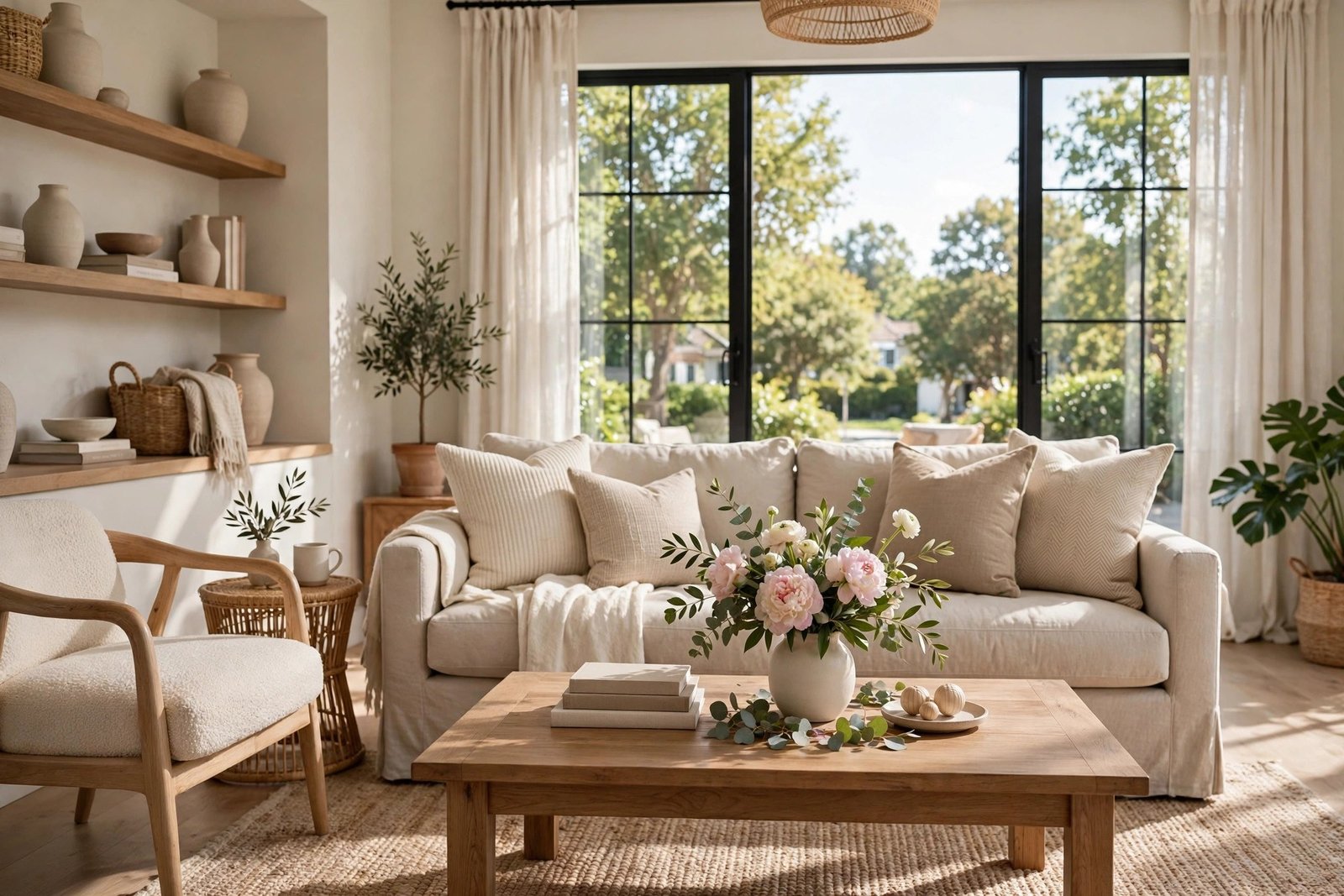
Staged homes sell faster and for more — the National Association of Realtors consistently finds buyers perceive staged homes as better maintained and worth higher offers. But professional staging costs $2,000–$5,000+, which stings when you’re already paying to move. The good news: the 20% of staging that delivers 80% of the impact costs almost nothing. Here’s where to stage on a budget, what to skip, and the cheapest sources for the pieces that matter.
The Free Foundation: Declutter, Depersonalize, Deep-Clean
Before spending a dollar, do the three free things that matter most. Declutter ruthlessly: remove 30–50% of visible items — crowded rooms feel small, and small feels cheap. Box it, store it (garage, storage unit, friend’s spare room). Depersonalize: family photos, diplomas, political items, and fridge magnets go into boxes. Buyers need to picture THEIR life, not admire yours. Deep-clean everything: baseboards, windows, grout, ceiling fans, inside the oven. A spotless $300,000 home outsells a grimy $350,000 one — cleanliness reads as “well-maintained” to buyer brains.
These three steps alone outperform expensive furniture rental in most price ranges. Professional stagers will tell you privately: half their job is convincing sellers to do what you just did for free.
The $200 Impact List: Where Small Money Goes Far
With roughly $200, you can transform buyer perception. Lighting: replace dim or mismatched bulbs with bright, matching daylight LEDs ($30–$50 for the whole house) — dark rooms photograph terribly and feel smaller. Fresh white towels and a new shower curtain ($40): bathrooms are judged in seconds, and these two items reset the entire impression. A new doormat and potted plants at the entry ($30): first impressions form in seven seconds, starting at the door. Fresh flowers or a bowl of lemons ($15): the oldest staging trick because it works — life and color signal “loved home.”
Paint touch-ups ($30 for a quart matched to existing walls): scuffed walls scream neglect; touched-up walls whisper maintenance. Focus on high-traffic areas — hallways, entry, kitchen. This pairs with the exterior work of improving curb appeal cheaply, since buyers decide half the verdict before stepping inside.
Cheapest Sources for Staging Pieces
Your own home, rearranged. The best staging inventory is furniture you already own, edited and repositioned. Pull furniture slightly away from walls (counterintuitively makes rooms feel larger), remove one piece per room (breathing space reads as square footage), and repurpose: that bedroom armchair becomes the living room reading corner.
Facebook Marketplace and thrift stores. A $25 mirror from Marketplace doubles a room’s perceived light; thrifted vases, baskets, and throw pillows ($2–$5 each) add the texture that makes spaces feel styled. Buy neutrals — beige, white, soft gray — which photograph best and appeal widest.
Borrow, don’t buy. Friends and family with nice plants, art, or accent furniture are an untapped staging warehouse. Offer to return everything within a month, and handle transport carefully.
Dollar stores and IKEA. New hand towels, candles (unlit — fire codes at open houses), simple frames, and matching hangers for closets (yes, buyers open closets, and matching hangers signal order). The National Association of Realtors’ staging data shows living room, kitchen, and primary bedroom matter most — concentrate spending there and leave guest rooms simple.
Room-by-Room Budget Priorities
Living room: declutter surfaces to three items max, add one throw pillow set in a current color, ensure seating faces a focal point. Kitchen: clear counters completely except one styled vignette (cookbook stand + plant), hide small appliances, polish the faucet. Primary bedroom: white or neutral bedding (borrow if needed — it’s the room’s entire impression), clear nightstands to lamp + book. Bathrooms: the towel/shower-curtain reset plus hide all personal products. Closets: half-empty them; spacious closets sell storage, and storage sells homes.
For smaller spaces, the same principles apply with extra emphasis — making compact spaces feel bigger uses identical tricks (mirrors, light colors, decluttering) whether you’re staging to sell or styling to live.
What to Skip
Don’t rent furniture for rooms that are fine — empty is better than cluttered, and “vacant” only hurts in large, echoing spaces. Don’t buy new art; depersonalized walls with one borrowed mirror beat personal galleries. Don’t stage the garage beyond sweeping it — buyers forgive garages. And don’t overspend on scent: one subtle candle or fresh flowers; plug-in air fresheners in every room read as “covering something up.”
Staging Photography: The Listing That Sells Before the Showing
Here’s the truth about modern home sales: your staging’s real audience isn’t the open-house visitor — it’s the phone-scroller. Over 90% of buyers start online, and they decide in seconds whether your listing earns a showing. That makes photography the highest-leverage part of budget staging, and it’s mostly free.
Shoot in daylight with all lights on and blinds open — bright photos get dramatically more clicks. Shoot from doorways and corners (the widest angles), at chest height, keeping verticals straight — tilted phone photos scream amateur and suppress inquiries. Declutter for the camera specifically: what looks fine in person photographs as chaos — remove small items from every surface before shooting. Stage one “hero shot” per key room: the living room’s best angle, the kitchen’s cleanest counter, the bedroom’s inviting bed. If your agent offers professional photography (many do, often free with the listing agreement), take it — pro photos measurably increase showings and final prices — Realtor.com’s seller resources confirm listings with professional photography attract significantly more views. Your $200 of staging props photographed professionally outperforms $2,000 of props photographed badly. In 2026, the camera is the first showing — stage for it.
The 48-Hour Pre-Listing Blitz
Two days before photos and showings, run this blitz: day one — subtract: remove everything that isn’t furniture or deliberate decor. Countertops cleared, closets half-emptied, garage swept, yard tidied, personal items boxed. Day two — add: fresh flowers, new hand towels, the entry plants, made beds with the good bedding, every light on, blinds open, toilet lids down, trash cans emptied and hidden.
The night before the first showing, do the “stranger walk”: enter through the front door as if you’ve never seen the place — what do you smell (cook something neutral or nothing at all that day), what do you see first (that’s your focal point — make it count), what’s the temperature (cool and comfortable, even if it costs a little extra A/C)? Buyers decide emotionally in the first 90 seconds and justify logically after. The blitz doesn’t change your house; it changes the first 90 seconds. And in real estate, the first 90 seconds change everything.
Conclusion
Staging on a budget is 80% free (declutter, depersonalize, deep-clean) and 20% strategic small spending ($200 on lighting, towels, entry plants, paint touch-ups, flowers). Source pieces from your own rearranged furniture, thrift stores, Marketplace, and borrowed items; concentrate on the living room, kitchen, and primary bedroom; and remember that cleanliness and space outperform expensive props every time. The cheapest place to stage your home is the home itself — edited ruthlessly and presented with intent.
Frequently Asked Questions
Where is the cheapest place to stage your home for open houses on a budget?
Start free: declutter, depersonalize, and deep-clean using what you own. For purchases, thrift stores, Facebook Marketplace, dollar stores, and borrowed items from friends cover everything that matters for under $200 total.
How much does professional home staging cost?
Typically $2,000–$5,000+ depending on home size and market. DIY budget staging ($0–$200) captures most of the impact through decluttering, cleaning, lighting, and strategic small purchases.
Which rooms matter most when staging?
The living room, kitchen, and primary bedroom influence buyers most, per National Association of Realtors data. Concentrate your effort and budget there; keep secondary rooms clean and simple.
Should I stage a home that’s already furnished?
Yes — “staging” a furnished home mostly means editing: remove 30–50% of visible items, depersonalize, rearrange for space and light, and add small fresh touches. You already own the inventory.
Do staged homes really sell for more?
Industry data consistently shows staged homes sell faster and often above asking compared to unstaged comparable homes, because buyers perceive them as better maintained and can envision living in them.