Knee pain creates a cruel catch-22: your knees hurt, so you stop moving, so the muscles supporting your knees weaken, so your knees hurt more. I’ve watched this cycle trap people I care about — including my own father, who went from “my knees are a little achy” to barely climbing stairs in two years of avoiding activity. The way out isn’t rest. It’s the right movement. And here’s the thing most people get backwards: properly chosen exercise doesn’t wear bad knees out — it rebuilds the support system around them.
So what are the best low-impact exercises for bad knees? The winners all share one trait: they strengthen the muscles around the knee without pounding the joint. Here’s your complete guide — what’s safe, what to avoid, and how to progress.
Why exercise helps bad knees (the science is clear)
This isn’t wishful thinking. Major guidelines — including the American College of Rheumatology — recommend exercise as a first-line treatment for knee osteoarthritis, on par with medication. Strong quadriceps act like shock absorbers, reducing the load on the joint with every step. Strong glutes keep the knee tracking properly instead of collapsing inward. And movement nourishes cartilage, which has no blood supply and depends on joint motion for nutrition. The research is unambiguous: people with knee arthritis who exercise regularly have less pain and better function than those who don’t. The key word is low-impact — high pounding is the enemy, not movement itself.
What are the best low-impact exercises for bad knees? The top tier
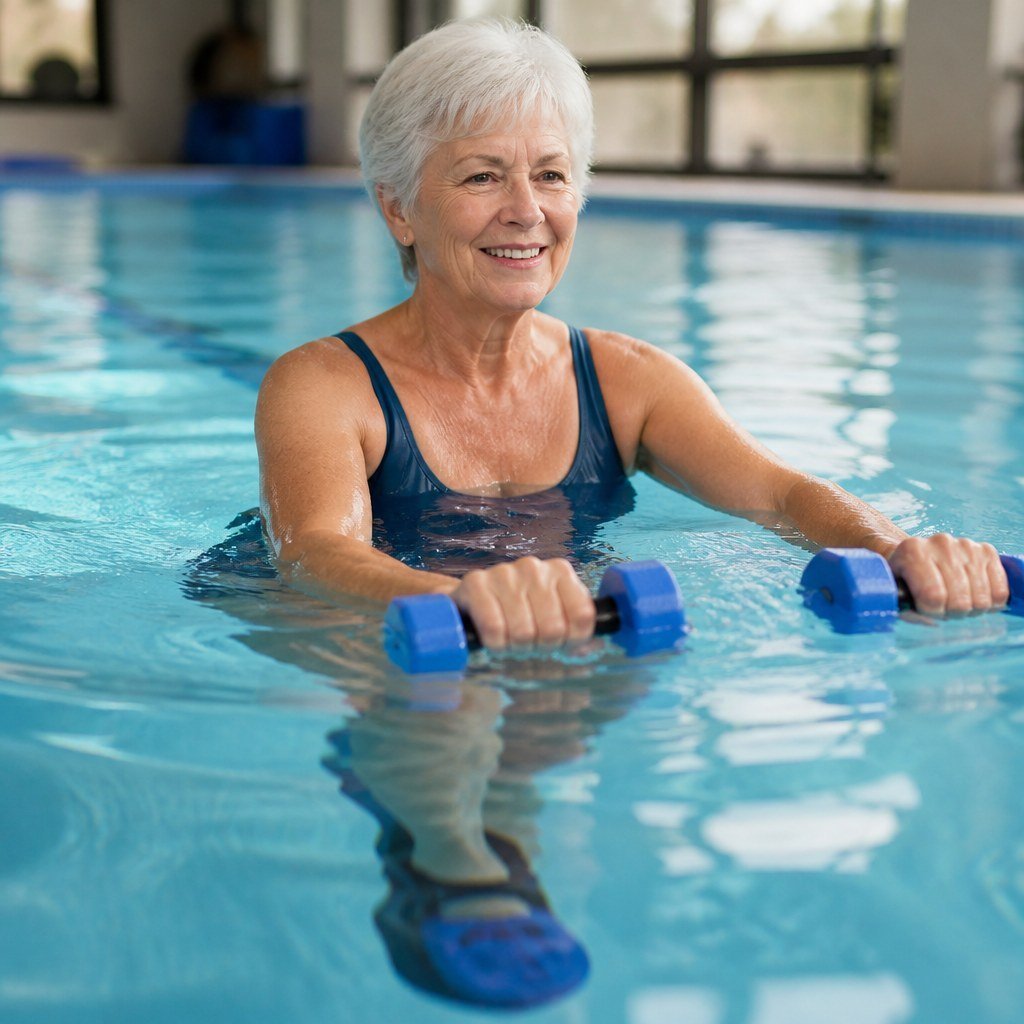
Swimming and water aerobics — the gold standard
Water unloads up to 90% of your body weight while providing smooth resistance in every direction. It’s the closest thing to a free pass for bad knees. Swim laps, walk laps in the shallow end, or join a water aerobics class — many YMCAs and community pools in South Florida offer them, and the social aspect keeps people coming back. If you have access to a pool, start here.
Cycling (stationary or outdoor) — the knee’s best friend
Cycling strengthens the quadriceps through a smooth, circular motion with zero impact. Set the seat high enough that your knee has only a slight bend at the bottom of the pedal stroke — too low a seat is the number one cause of cycling knee pain. Start with 10–15 minutes of easy spinning and build gradually. Recumbent bikes are even gentler if upright bikes bother you.
Walking — with the right surface and shoes
Walking gets a bad rap for knees, but on soft surfaces (tracks, grass, treadmills) with supportive shoes, it’s excellent — it’s also how you hit daily step goals for general health. Avoid steep hills initially, keep strides short, and consider walking poles, which offload the knees significantly while adding an upper-body workout.
Elliptical and rowing machines
The elliptical mimics running motion without the impact — keep resistance moderate and avoid the incline at first. Rowing is a phenomenal full-body option that’s nearly all legs-and-core with no knee pounding, though very deep knee bends at the catch can bother some people; limit the slide range if needed.
Strength exercises that protect knees
Cardio is only half the equation. These targeted strengtheners are what actually stabilize the joint:
- Straight-leg raises: lie down, tighten your thigh, lift your straight leg 6 inches. Boring, incredibly effective quad builder with zero knee bending.
- Glute bridges: hips up, squeeze, lower. Strong glutes prevent the knee cave-in that grinds cartilage.
- Wall sits (shallow): slide down only a few inches — you don’t need 90 degrees. Even a shallow hold builds serious quad endurance.
- Step-ups (low step): a 4–6 inch step, slow and controlled. This is functional — it’s literally stair training.
- Clamshells and side-lying leg raises: hip stabilizers that keep knees tracking straight.
- Seated knee extensions (light): controversial in some circles, but light, pain-free extensions rebuild the quad’s inner muscle (VMO) that wastes away with knee pain.
Start with 2 sets of 10–12 reps, twice a week. Mild muscle burn is fine; sharp joint pain is not — that’s the bright line. home strength-training principles apply here too: progress gradually.
What to avoid (and what’s misunderstood)
Truly avoid: deep squats past 90 degrees, lunges with the knee driving far forward, high-impact running and jumping, and kneeling on hard surfaces. Full lotus-type positions and deep knee bends under load grind the kneecap.
Misunderstood: stairs (fine in moderation — they’re just step-ups), leg extensions (fine light and pain-free despite old myths), and — the big one — the idea that “bone on bone” on an X-ray means exercise is dangerous. Imaging severity correlates poorly with pain and function; plenty of people with rough-looking X-rays move great with strong muscles.
Pain management and practical tips
Some ache during or after exercise is normal when starting — think 3/10 or less, settling within a couple of hours. Manage it smartly: warm up 5 minutes before, ice 10–15 minutes after if knees feel hot or swollen, and consider gentle stretching NSAIDs (often as effective as pills for knee OA with fewer systemic effects). Lose excess weight if applicable — every pound lost unloads roughly four pounds of knee force per step, which is the highest-leverage intervention that exists. Supportive, cushioned shoes matter more than expensive knee braces for most people. And if pain is sharp, swelling, locking, or giving way, see a doctor or physical therapist — a few PT sessions to learn correct form pay for themselves many times over.
The American Academy of Orthopaedic Surgeons offers excellent patient guides on knee-friendly exercise if you want a second authoritative source.
The takeaway
The best low-impact exercises for bad knees — swimming, cycling, walking on soft surfaces, elliptical, rowing, plus targeted quad/glute/hip strengthening — don’t just avoid harming your knees; they actively make them better by rebuilding the muscular support system. Start gentle, progress gradually, respect sharp pain but don’t fear all discomfort, and give it 6–8 weeks. Strong muscles are the best knee brace ever invented, and you can build them at any age.