Palm Beach is running out of excuses for treeless yards. Between new developments, hurricane losses, and the slow fade of aging landscaping, the area’s tree canopy needs help — and planting trees that support local wildlife is one of the highest-impact things a beginner can do for the environment. A single native tree feeds dozens of bird species, hosts hundreds of caterpillar species (baby bird food), shades your home, and raises your property value. But plant the wrong tree and you’ve created a maintenance nightmare that helps nothing.
This is the beginner-safe guide: which trees actually help Palm Beach wildlife, how to plant them so they survive, and the mistakes that kill most first attempts.
Why Native Trees Matter More Than Any Trees
Wildlife co-evolved with native plants over thousands of years. A native live oak can host over 500 species of caterpillars; a non-native ornamental might host five. Since caterpillars are the primary food for nesting birds (a single chickadee family needs thousands per season), the tree you choose directly determines how much wildlife your yard supports. This isn’t gardening snobbery — it’s ecology. The National Wildlife Federation’s native plant research consistently shows native trees support exponentially more wildlife than exotic ornamentals.
Native trees also survive Palm Beach conditions better: they’re adapted to our sandy soil, rainy summers, dry winters, and hurricane winds. A native tree planted correctly needs far less water, fertilizer, and babysitting than an exotic showpiece.
The Best Beginner Trees for Palm Beach Wildlife
Live oak (Quercus virginiana)
The undisputed champion. Massive wildlife value, iconic beauty, hurricane-resistant once established, and very long-lived. Needs space — mature canopy spreads 60+ feet — so it’s for larger lots. If you have room, plant one; your great-grandchildren’s wildlife will thank you.
Sabal palm (Sabal palmetto)
Florida’s state tree, and nearly indestructible. Provides nesting sites and fruit for birds and mammals, survives hurricanes that shred other palms, and tolerates any soil. The perfect beginner tree — plant it and basically ignore it.
Red maple (Acer rubrum)
Fast-growing, beautiful fall color (yes, in Florida — subtle but real), and excellent for birds and pollinators. Likes moist spots, making it ideal for low areas of Palm Beach yards.
Wild coffee (Psychotria nervosa)
Technically a large shrub/small tree — perfect for beginners with small yards. Evergreen, shade-tolerant, produces berries birds devour, and hosts pollinators with fragrant white flowers. Plant it under existing trees where nothing else thrives.
Firebush (Hamelia patens)
A shrubby hummingbird magnet with tubular red-orange flowers nearly year-round in South Florida. Fast-growing, drought-tolerant once established, and dies back in freezes only to return. Hummingbirds will find it within days.
For smaller spaces, container and balcony gardening techniques adapt well to native shrubs — and cheap raised beds can host native wildflowers beneath your trees, multiplying wildlife value.
Planting So They Survive: The Technique
Most beginner tree deaths come from planting errors, not bad trees:
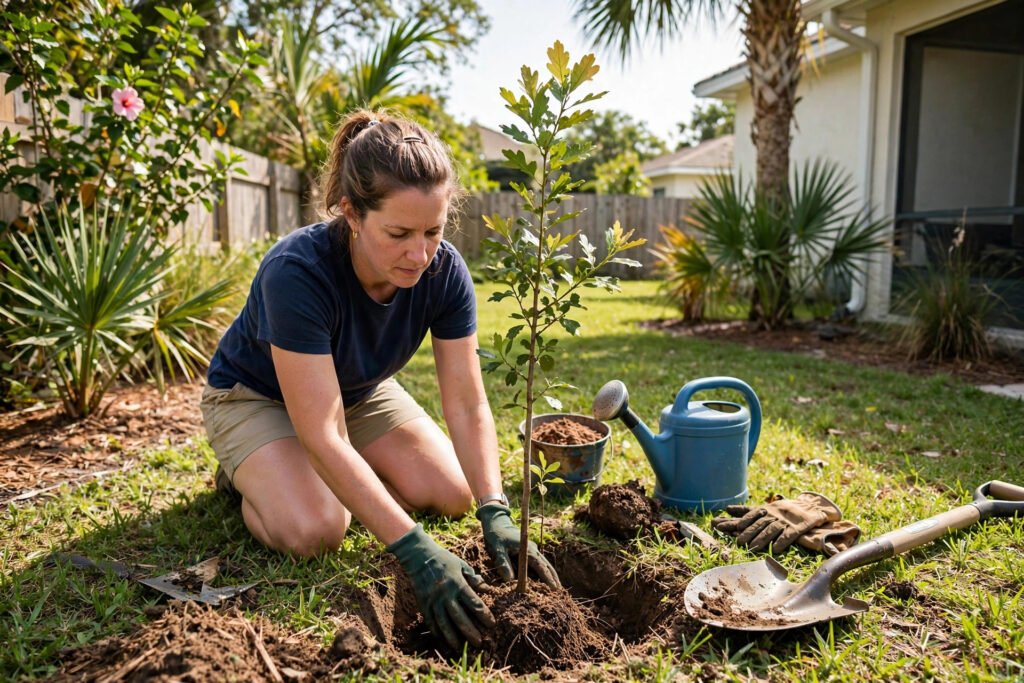
- Dig wide, not deep. The hole should be 2–3 times the root ball’s width but no deeper than the root ball’s height. Planting too deep suffocates roots — the number-one killer.
- Find the root flare. The trunk should widen slightly where it meets roots. That flare must sit at or slightly above ground level, never buried.
- Don’t amend the backfill much. Palm Beach’s sandy soil is what natives expect. Heavy amendment creates a “bathtub” that holds water and rots roots.
- Mulch, don’t volcano. A 2–3 inch mulch ring (kept away from the trunk) retains moisture and suppresses weeds. Piled against the trunk (“mulch volcanoes”) causes rot — the most common professional landscaping mistake in Florida.
- Water deeply but infrequently. New trees need regular water for the first year — deep soakings that encourage deep roots, not daily sprinkles that keep roots shallow. Then taper off; natives should survive on rainfall.
Timing and Hurricane Wisdom
Plant at the start of the rainy season (June) so nature does your watering, or in fall/winter when transplant shock is lowest. Avoid planting at summer’s peak heat.
Hurricane reality: young trees need staking for the first year in windy sites, but remove stakes after 12 months — trees that never sway develop weak trunks. Choose species wisely: live oaks and sabal palms are famously wind-resistant; avoid brittle species like Norfolk pines near structures. Proper pruning (never “topping” or “hat-racking”) builds storm-resistant structure — the University of Florida’s IFAS Extension publishes excellent free pruning guides for Florida trees.
What NOT to Plant
Avoid invasive species regardless of how pretty they are: Brazilian pepper, Australian pine, melaleuca, and carrotwood destroy native habitat and are illegal to plant in many Florida contexts. Also skip trees with known problems for beginners: ficus (aggressive roots destroy plumbing and sidewalks), large eucalyptus (brittle in storms), and anything the nursery can’t tell you the mature size of. When in doubt, the Florida Native Plant Society’s plant database is the authority.
Getting Free or Cheap Native Trees in Palm Beach
Beginners often assume trees are expensive, but Palm Beach County practically gives native trees away. The county’s native plant sales, the Florida Native Plant Society’s local chapter events, and Arbor Day giveaways distribute free or low-cost native saplings regularly. Many municipalities offer free trees to residents for planting in yards — check your city or the county extension office. Big-box garden centers charge $30–$80 for the same native species you can get for $5–$15 at native plant sales, and the sale plants are typically healthier, grown from local seed stock already adapted to your exact conditions.
When buying, choose smaller container sizes (1–3 gallon). Counterintuitively, smaller trees establish faster than large ones — a 3-gallon live oak often overtakes a 15-gallon specimen within three years because its roots establish without circling. Smaller trees are also plantable by one beginner with a shovel, no crew required.
Conclusion
Planting trees that help local wildlife in Palm Beach as a beginner comes down to: choose natives (live oak, sabal palm, red maple, wild coffee, firebush), plant at the right depth with the root flare exposed, mulch properly, water deeply through year one, and never plant invasives. One well-chosen native tree does more for local birds, pollinators, and the environment than a yard full of exotic ornamentals — and it’ll outlive us all. Plant it this rainy season.
Frequently Asked Questions
What is the best tree to plant for wildlife in Florida?
Live oak supports the most wildlife species overall. For small yards, sabal palm and wild coffee offer excellent wildlife value in compact spaces. Native species always outperform exotics for wildlife support.
When is the best time to plant trees in Palm Beach?
Early rainy season (June) lets rainfall establish the tree, or fall/winter for lowest transplant stress. Avoid peak summer heat for planting.
How often should I water a newly planted tree?
Deeply 2–3 times per week for the first few months, tapering through the first year. Deep, infrequent watering builds deep roots; daily light sprinkling creates weak, shallow root systems.
What trees should I avoid planting in Florida?
Invasive species (Brazilian pepper, Australian pine, melaleuca), plus problem trees like ficus near structures. Always check mature size before planting — the number-one landscaping regret.
Do native trees really need less maintenance?
Yes — they’re adapted to local soil, rainfall, and pests. Once established (typically one year), most Florida natives thrive on rainfall alone with occasional pruning.