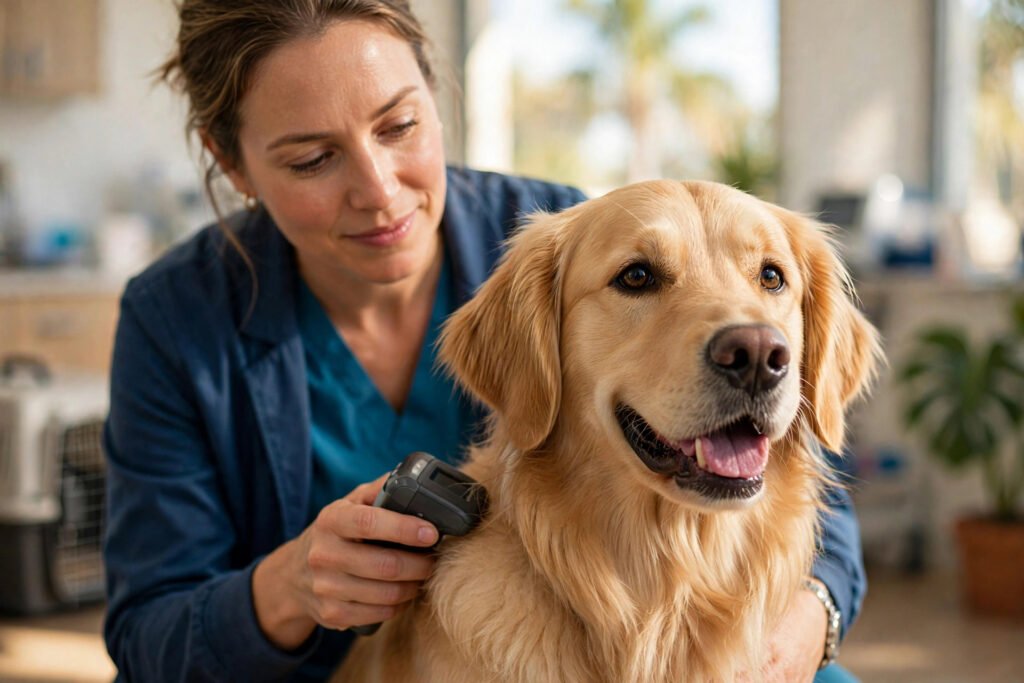
When Maria Delgado’s terrier mix slipped out of her Miami backyard during a thunderstorm, the dog had no collar and her phone number had changed months earlier. Three days later, a shelter thirty miles away scanned the tiny chip under the dog’s skin and called her. That chip, no bigger than a grain of rice, was the only reason her dog came home. Yet most pet owners have heard of microchipping without understanding how the rules actually work — what the chip does, what it doesn’t do, and the one registration step that makes or breaks the whole system.
This guide walks through pet microchipping rules the way they actually function in the United States in 2026: the technology, the standards mess behind the scenes, what Florida and local governments require, what it costs, and the mistakes that leave chipped pets unidentifiable anyway.
How a Microchip Actually Works
A pet microchip is a passive radio-frequency identification (RFID) transponder sealed in biocompatible glass, about 12 millimeters long — roughly the size of a grain of rice. A veterinarian injects it under the loose skin between your pet’s shoulder blades with a large-bore needle. The procedure takes seconds, feels like a routine vaccination to the animal, and needs no anesthesia. Once implanted, the chip sits dormant. It has no battery and emits nothing on its own.
When a shelter, vet clinic, or animal control officer passes a handheld scanner over the area, the scanner’s electromagnetic field briefly powers the chip, which transmits back a unique identification number. That number is the entire payload — there is no name, address, or medical history stored on the chip itself. The number is only useful because it is linked to your contact details in a registry database. This is the single most misunderstood part of microchipping: the chip is a key, not a filing cabinet.
One more myth to kill early: microchips are not GPS trackers. They cannot show your pet’s location or be tracked from your phone. If you want live location tracking, that is a separate product — a GPS collar tag.
The Rule Most Owners Break Without Knowing: Registration
A landmark Ohio State University study found that microchipped dogs were returned to owners 52.2 percent of the time, versus 21.9 percent for non-chipped dogs — and for cats, 38.5 percent versus 1.8 percent. But the study also found that a large share of chipped shelter animals had chips that were never registered or linked to a disconnected number. The chip worked perfectly. The human failed.
The rule is simple: implantation is step one; registration is step two, and step two is on you. Many vets implant the chip and hand you a pamphlet with a registry website. Some enroll the pet automatically; many do not. Weeks later, owners assume “my pet is chipped” while the chip number floats in a database with no owner attached.
To verify your registration, ask your vet to scan your pet at the next visit and give you the chip number, then search it on the AAHA Universal Pet Microchip Lookup tool. If your number returns no owner, register it immediately — many registries offer free lifetime enrollment. Then update the record every time you move or change phone numbers.
US Chip Standards: The Frequency Problem Nobody Told You About
The United States has a quiet technical split that still trips people up. The international standard (ISO 11784/11785) uses 134.2 kHz chips with 15-digit numbers, and it is what most of the world — and increasingly the US — uses. But older American chips from companies like AVID and HomeAgain used 125 kHz or 128 kHz frequencies with 9- or 10-digit numbers, which single-frequency scanners cannot read.
The practical rule: make sure any facility that might scan your pet uses a universal (multi-frequency) scanner — now the norm at US shelters and clinics. If your pet was chipped many years ago with a 125 kHz chip, ask your vet whether it still reads on their current scanner. If there is any doubt, implanting a second ISO-standard chip is cheap and harmless, and both numbers can be registered to you. Note the chip’s manufacturer and number in at least two places — your phone and a cloud note — so you can quote it if your pet is found.
What Florida and Local Governments Actually Require
Florida has no statewide microchip mandate — the rules live at the county and city level. Several Florida counties require microchipping for dogs adopted from public shelters, and Miami-Dade County requires dogs to be licensed, with animal services strongly pushing chipped-and-registered as the standard for getting lost dogs home fast.
Beyond government rules, private rules matter more daily: many Florida landlords, condo associations, boarding kennels, and groomers now ask for microchip numbers. And if you travel with your pet, note that Hawaii’s quarantine program and several international destinations effectively require ISO-standard microchips — implanted before the rabies titer blood test, since a chip implanted after the blood draw can invalidate the timeline. If an overseas move is even a possibility, get the ISO chip now.
The takeaway for understanding keeping your pet safe while traveling is that identification rules stack: the chip satisfies the strictest layer, so meeting that standard covers the easier ones automatically.
Costs, Lifespan, and What to Ask Your Vet
In 2026, microchip implantation at a US vet clinic typically costs $25 to $75; low-cost clinics and shelter events frequently offer it for $15 to $25. Registration ranges from free lifetime enrollment to roughly $20 per year — read the terms, because some registries charge for updates, and a registry that charges you to change your phone number is one you will avoid updating. The chip itself is designed to last the animal’s lifetime with no maintenance.
Questions worth asking your vet: which frequency and standard is the chip (134.2 kHz ISO, ideally)? Do you enroll it for me or do I? Is registration lifetime or annual, and are updates free? The AVMA’s microchipping FAQ for pet owners covers the same ground and is worth a read before your appointment.
If Your Pet Goes Missing: The Chip Workflow
When a lost pet reaches a shelter or vet, staff scan for a chip as one of the first steps, then call the registry, which contacts you. Your job in the first hours: confirm your registry contact details are current right now and report the pet as lost with the registry (most have a lost-pet alert feature). Shelters hold strays for a legally defined period — often three to five days in Florida counties — before the animal can be adopted out, so speed matters.
Also notify your vet, since some finders bring animals to clinics rather than shelters. And if you are choosing a low-maintenance pet for apartment living, remember that small indoor pets get lost too — cats slip through cracked doors and rabbits bolt from patios, and a chip is the cheapest insurance policy ever invented for a creature that cannot tell anyone its address.
Conclusion
The best way to understand pet microchipping rules is to stop thinking of the chip as the product and start thinking of the registration as the product. The implant is a one-time, sub-$75 procedure using a passive RFID chip that lasts a lifetime. The rules that matter — register the number yourself, verify it on the AAHA lookup tool, keep your phone number current, and confirm your vet uses a universal scanner — are all human steps, and they are where the system succeeds or fails.
Frequently Asked Questions
Does a microchip hurt my pet?
The injection feels similar to a routine vaccination — a brief pinch. Most pets react less than they do to a nail trim. No anesthesia is needed, and there is no recovery period.
Can a microchip track my pet’s location?
No. Microchips are passive RFID with no battery and no GPS. They only transmit an ID number when a scanner is held close. For live tracking, you need a separate GPS collar device.
How much does microchipping cost in Florida?
Typically $25 to $75 at a vet clinic, or $15 to $25 at low-cost and shelter events. Registration is often free for life, though some registries charge around $20 per year.
What if my pet was chipped years ago and I never registered it?
Have your vet scan for the chip number, then register it with a pet recovery registry immediately. An unregistered chip cannot reunite anyone — but late registration fully fixes the problem.
Do I need to update the chip if I move?
Yes — update your registry contact details every time you move or change phone numbers. An outdated number is one of the top reasons chipped pets are never reunited with owners.