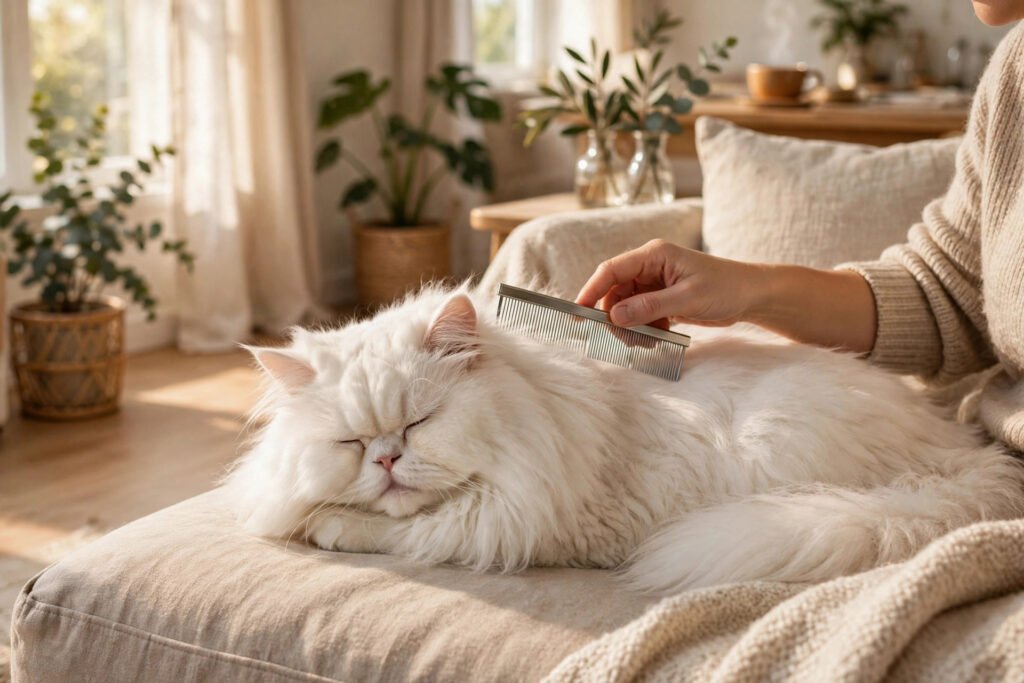
Palm Beach humidity is a special kind of enemy for long-haired cats. The same warm, moist air that frizzes human hair turns a Persian’s or Maine Coon’s coat into a matted, tangled landscape within days — and matted fur isn’t just ugly, it’s painful, pulling constantly on the skin and hiding sores, parasites, and infections underneath. Professional grooming in Palm Beach runs $70 to $120 per session, and long-haired cats need it every 4–6 weeks. That’s up to $1,400 a year.
The good news: with the right tools and a calm routine, you can handle 90 percent of long-haired cat grooming at home, reserving the groomer for the occasional lion cut or mat emergency. Here’s the complete at-home system, adapted for Florida’s climate.
The Tool Kit: What You Actually Need
Forget the 20-piece grooming kits. Four tools do the real work: a steel greyhound-style comb (the single most important tool — if the comb glides through, there’s no mat), a slicker brush for surface smoothing, a mat splitter or dematting comb for tangles that have already formed, and round-tipped scissors for careful mat removal. Add a quiet, low-heat pet dryer or even a regular hair dryer on cool — Florida air-drying in humidity can take hours and leaves the undercoat damp, which mats faster.
Buy quality once: a $25 steel comb outlasts five $8 plastic brushes and does a better job. Avoid Furminator-style deshedding blades on long-haired cats unless your vet approves — used aggressively, they cut the guard hairs and damage the coat you’re trying to protect. The ASPCA’s cat grooming guide covers the same essentials, and Cornell University College of Veterinary Medicine offers additional feline coat-care guidance worth bookmarking.
The Daily 5-Minute Routine (Yes, Daily)
In Palm Beach’s humidity, “weekly brushing” is a fantasy that ends in mats. Long-haired cats need 5 minutes of combing every single day — less time than scrolling your phone, and the difference between a silky coat and a $120 dematting appointment. The technique: work in layers. Lift the top coat with one hand and comb the undercoat underneath first — that’s where mats start, hidden against the skin. Then comb the top coat smooth. Always comb in the direction of hair growth, and never yank; hold the base of the fur near the skin while you work a tangle so you’re not pulling skin.
Hit the mat zones every session: behind the ears, under the collar area, the armpits (“wingpits” in groomer slang), the belly, and the britches (the fluffy rear thighs). These five spots generate 90 percent of mats. A cat that learns the daily routine as a kitten will purr through it; an adult new to grooming needs the gradual introduction in the next section.
Training a Cat to Accept Grooming
Adult cats that were never groomed often treat the brush like a personal insult. The fix is desensitization, not wrestling. Week 1: let the cat sniff the tools, treat for calm interest. Week 2: one gentle stroke with the comb, then a high-value treat (freeze-dried chicken works wonders); stop while it’s still pleasant. Week 3: extend to 2–3 minutes, always ending before the cat gets annoyed. Watch the tail — swishing means “I’m done,” and pushing past it teaches the cat that grooming ends in a fight.
Timing matters: groom after play or a meal when the cat is mellow, never when they’re in zoomie mode. Keep sessions short and pair them with something the cat loves. Many owners do the daily comb during evening TV time — the cat learns that the couch, the comb, and chin scratches come as a package. If your cat is one of many dealing with sensitive skin, use an even lighter touch and watch for flinching, which can signal skin irritation under the coat.
Dealing With Mats: The Safe Removal Protocol
Despite daily combing, mats happen — especially in the armpits and belly. Never cut a mat out with regular scissors pointed at the skin. Cat skin is paper-thin and tents up into mats; emergency vets see lacerations from well-meaning owners every week. The safe protocol: for small, loose mats, work cornstarch or a detangling spray into the mat and tease it apart with the mat splitter, working from the outer edge inward. For tight mats, slide the steel comb between the mat and the skin as a guard, then cut above the comb with round-tipped scissors — the comb protects the skin. For large, tight, or skin-level mats: stop and book a groomer or vet. A $40 mat removal is cheaper than stitches.
Never bathe a matted cat hoping to loosen things up — water tightens mats into felted clumps that can only be shaved. Demat first, bathe second, always.
Bathing: Rarely, and the Florida Way
Most long-haired cats need bathing only every 2–3 months — or when they get into something. Over-bathing strips the coat’s natural oils and causes the exact frizz you’re fighting. When you do bathe: use lukewarm water and a cat-specific shampoo (never dog shampoo, never dish soap — pH matters), lather gently without scrubbing tangles in, rinse exhaustively (residue irritates skin and attracts dirt), and then dry completely. This is the step Palm Beach owners skip: in 80 percent humidity, a “towel-dried” long-haired cat stays damp at the skin for hours, and damp undercoat mats aggressively. Use the dryer on low/cool while combing, until the comb glides freely. The full bath-to-fluffed routine takes 45–60 minutes — which is exactly why daily combing matters more than frequent bathing.
Between baths, waterless foam shampoos handle the sanitary trim area and paws. And keep the rear trimmed — a “sanitary clip” around the backside prevents the hygiene disasters long hair invites. Your groomer can show you the safe technique once, and you’ll handle it at home after that.
Nails, Ears, and Eyes: The Rest of the Routine
While you’re grooming, fold in the rest: trim nails every 2–3 weeks (just the sharp tip, avoiding the pink quick), check ears weekly for dark waxy buildup (a little is normal; coffee-ground debris suggests ear mites), and wipe tear staining around the eyes of flat-faced breeds like Persians with a damp cloth daily — tear ducts in brachycephalic cats drain poorly, and the dampness stains and irritates. A home that manages all of this stays fresher too, complementing efforts like keeping your home smelling fresh without air fresheners.
Conclusion
The best way to groom a long-haired cat at home in Palm Beach is a system, not a struggle: the right four tools, five minutes of layered combing every day (non-negotiable in this humidity), gradual training for reluctant cats, safe mat removal with a comb-guard, and rare but thorough baths with complete drying. Master that routine and you’ll cut your grooming bills by two-thirds while your cat stays mat-free, comfortable, and gorgeous. The groomer becomes a twice-a-year luxury, not a monthly emergency.
Frequently Asked Questions
How often should I brush my long-haired cat?
Daily — 5 minutes of combing every day, especially in humid climates like Palm Beach. Weekly brushing isn’t enough for long-haired breeds and leads to painful matting.
Can I cut mats out of my cat’s fur myself?
Small loose mats can be teased apart with a mat splitter. For cutting, always slide a steel comb between the mat and skin as a guard and cut above it with round-tipped scissors. Large or skin-tight mats should go to a groomer — cat skin tears very easily.
How often should I bathe my long-haired cat?
Every 2–3 months is plenty for most indoor long-haired cats. Over-bathing strips natural oils. Always dry completely afterward — damp undercoat in Florida humidity mats quickly.
Why does my cat’s fur mat so fast in Florida?
Humidity is the culprit: moisture swells the hair shaft and makes strands tangle and felt together faster. Daily combing, complete drying after baths, and air conditioning all fight the climate effect.
Should I shave my long-haired cat for summer?
A professional lion cut can help severely matted or heat-stressed cats, but routine shaving isn’t necessary and removes insulation that actually regulates temperature. Daily grooming usually manages summer coats fine — discuss it with your vet first.