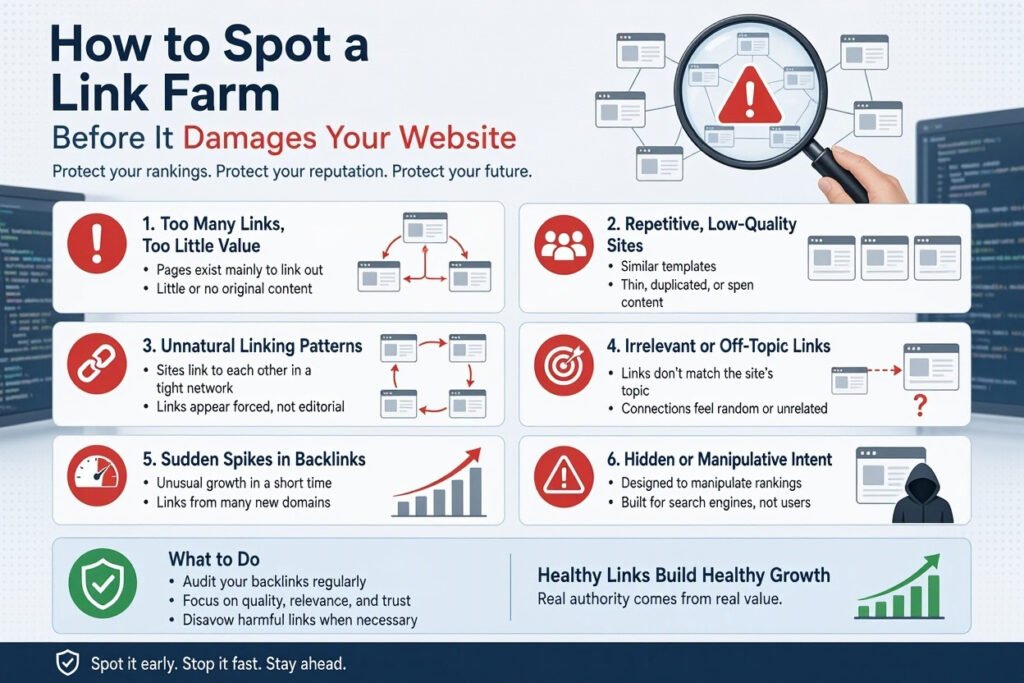
A sudden offer of hundreds of backlinks for a low fee can sound like an easy way to improve a website’s visibility. But links from sites built mainly to sell or exchange links may bring little value and can create SEO risks. Knowing how to spot a link farm helps business owners, publishers and marketers avoid paying for a shortcut that could undermine the trust they are trying to build.
A link farm is a group of websites or pages created primarily to link to one another, or to other sites, rather than to serve a real audience. Some schemes are obvious; others dress up as blogs, directories or guest-posting networks. A single unfamiliar link does not prove a site is part of one. Look instead for patterns: thin content, unrelated topics, unnatural linking and a lack of signs that real readers use the site.
Start with the site itself
Open several pages, not just the homepage or the article where your link might appear. Ask what the site is for and who would read it. A legitimate publication usually has a recognizable subject, a consistent editorial approach and articles that answer questions or report useful information. A suspicious site may publish an article about home repairs beside one about cryptocurrency, then switch to pet health and casino offers, with no clear audience connecting them.
Mixed topics alone are not proof. General-interest publishers cover many subjects, and freelancers may contribute across categories. The warning sign is a site with no coherent point of view, where pages feel assembled to host links rather than inform readers. Check whether the articles offer specific explanations, reporting or experience—or repeat generic paragraphs that could fit almost any website.
Inspect the links and publishing patterns
Look at the outgoing links in a few recent posts. Do they point naturally to sources that support the article, or do they lead to commercial sites in unrelated industries? If every post contains several exact-match phrases linking to businesses, and those links seem disconnected from the text, the site may be selling placements without meaningful editorial judgment.
Also check the site’s own incoming and outgoing link patterns using reputable SEO tools, if you have access to them. A sharp increase in links from a cluster of similar sites, repeated links between the same domains, or anchors that all use the same sales-focused wording deserve closer review. These indicators are clues, not a verdict: legitimate sites can share ownership, and a new site may have few links simply because it is new.
Publishing cadence can reveal more. A site that posts dozens of short articles each day across unrelated subjects, with multiple commercial links in each, is operating differently from a publication with a clear audience and an editorial rhythm. Check author pages, dates and whether older stories are maintained. Missing bylines or contact details do not automatically make a site harmful, but a complete absence of accountability adds to the concern.
Do not judge by metrics alone
Third-party tools estimate traffic, authority or link strength; they do not certify that a website is trustworthy. A high score can be misleading if the site has a poor editorial record, and a small local publication may have genuine readers despite modest metrics. Consider the full picture: topic relevance, content quality, audience, link context and the site’s apparent reason for publishing.
Before accepting a placement, read the actual page and ask whether the link helps its reader. Would someone interested in the article naturally want to visit the linked business? Is the destination accurately described? Would the article still make sense if the link were removed? If the answer is no, the placement may be designed for search engines rather than people.
Choose safer ways to earn links
Useful links tend to follow useful work: original research, clear expert commentary, practical tools, strong local reporting or genuinely helpful guides. Guest posts can also reach relevant audiences when they are written for the publication’s readers, not produced as a vehicle for keyword-heavy links. When considering guest posting opportunities, apply the same checks you would use for any publisher: review its articles, audience and linking practices before committing.
For digital businesses, marketing decisions are only one part of a launch plan. A company building an app, for example, needs to budget for the product separately from promotion; Osdire’s app development cost breakdown can help frame that development expense. Neither a large build budget nor a promise of fast rankings makes questionable link placements a sound investment.
Keep a record of the sites you approach, the pages where links appear and the reason each placement fits your audience. If you discover paid or manipulative links pointing to your site, review the situation with an SEO professional before taking action. Search engines’ policies and tools can change, so avoid panic responses based on one report or one unfamiliar domain.
A quick review before you say yes
- Does the site have a clear subject and a plausible audience?
- Do its articles provide useful information beyond hosting links?
- Are links relevant to the surrounding discussion and the reader’s needs?
- Do publishing volume, repeated anchors or cross-linking patterns look manufactured?
- Can you identify who publishes the site and how to contact them?
No single checklist can classify every website perfectly. The practical goal is to slow down before buying a placement and judge the whole publication, not one metric or sales pitch. If a site would be a poor place for your customers to discover your work, it is unlikely to become a valuable link simply because it promises SEO results.
For a deeper look at common warning signs and how they are changing, read this guide on how to spot a link farm. The core test remains straightforward: a sound link belongs in useful content, on a site with a reason to exist beyond selling links.