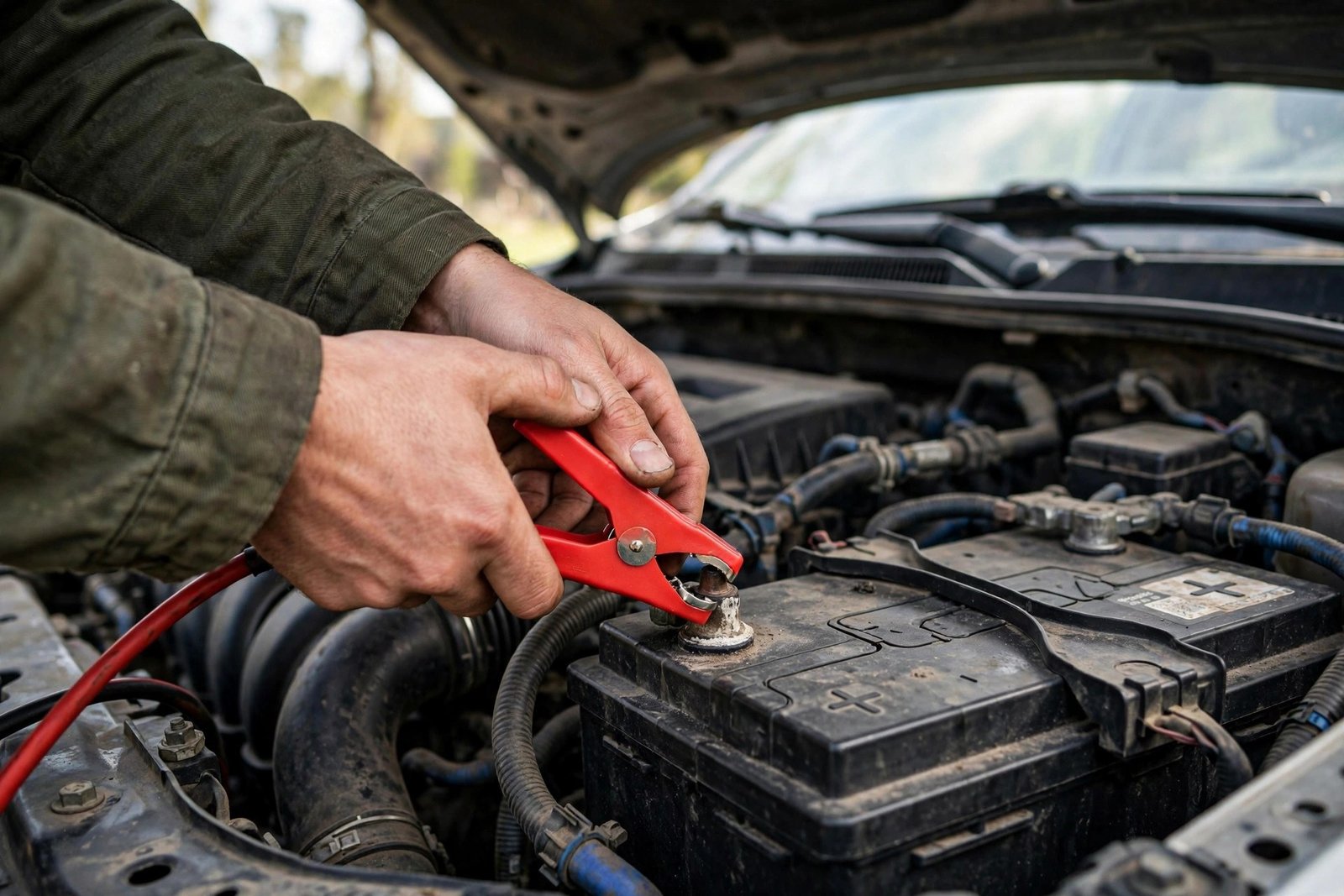
It’s 7 AM, you’re already late, and the car answers the key with a sad click-click-click. Jump-starting seems simple — red to red, black to black, right? — but do it wrong and you can fry electronics, weld a wrench to the terminal, or in rare cases cause a battery explosion. In Orlando’s heat, dead batteries are MORE common, not less (heat kills batteries faster than cold). Here’s why jump-starting trips people up and exactly how to do it right.
Why It’s Harder Than It Looks
Three things make jump-starts tricky: order matters (connect wrong and you create sparks near hydrogen gas batteries vent), modern cars are electronic minefields (voltage spikes can damage ECUs, infotainment, and driver-assist systems costing thousands), and not every “dead battery” is just a dead battery (a failing alternator or parasitic drain means the jump works for ten minutes, then you’re stranded again — angrier).
Orlando adds its twist: Florida heat evaporates battery fluid and corrodes terminals faster, so “dead” batteries here are often batteries that were dying for months. If your battery is 3+ years old in Florida, the jump-start is a warning, not a fix — plan replacement immediately. The same heat-awareness behind extending any battery’s life in hot climates applies quadrupled to the big one under your hood.
The Correct Procedure, Step by Step
1. Safety first: both cars off, parking brakes on, no smoking, remove metal jewelry. Check the dead battery for cracks, leaks, or bulging — if damaged, DON’T jump it; call for a tow. 2. Position: cars close but not touching. 3. Connect in this exact order: RED clamp to dead battery’s POSITIVE (+) terminal → RED clamp to good battery’s POSITIVE (+) → BLACK clamp to good battery’s NEGATIVE (−) → BLACK clamp to an unpainted metal ground on the dead car (engine block bolt, strut tower) — NOT the dead battery’s negative terminal. This last step is what everyone gets wrong: grounding away from the battery keeps sparks away from vented hydrogen.
4. Start the good car, let it run 2–3 minutes. 5. Start the dead car. If it doesn’t start in 3–4 tries (15 seconds cranking max each), stop — the problem isn’t just the battery. 6. Remove cables in REVERSE order: black ground first, then black from good battery, then red from good battery, then red from dead battery. 7. Keep the revived car running — drive 20–30 minutes (not just idle) to recharge. Then drive straight to have the battery and charging system tested; most auto parts stores do this free.
Why Orlando Batteries Die (Prevention)
Heat is the #1 battery killer — Florida batteries average 2–3 years versus 4–5 elsewhere. Prevention: have the battery tested annually after year two (free at most parts stores), clean corroded terminals with baking soda and water, ensure the battery is secured (vibration kills), and minimize short trips (the starter drains more than a 5-minute drive replenishes). A $15 battery terminal cleaner and annual test beats a $200 emergency replacement plus a missed morning. Consumer Reports’ car-battery buying guide helps you choose the right replacement when the time comes.
Consider a portable jump starter ($60–$100 lithium pack) — it lives in your trunk, needs no second car, and in AAA’s experience, AAA notes self-sufficiency beats waiting 45 minutes for roadside assistance in Orlando traffic. Charge it every 3–4 months; a dead jump starter is just a paperweight.
When NOT to Jump-Start
Don’t jump: cracked/leaking/frozen batteries, batteries with a strong sulfur smell, hybrids and EVs with high-voltage system warnings (their 12V aux batteries CAN be jumped, but the procedure differs — check your manual; the high-voltage system is strictly professional-only), or when cables are damaged. And if the car needed jumps twice in a month, stop jumping and start diagnosing — you’re treating a symptom. That diagnostic discipline mirrors properly assessing any used component’s health rather than assuming the obvious cause.
Jump-Starting Hybrids: What’s Different
Hybrids have TWO electrical systems — the high-voltage traction battery (which you must NEVER touch) and a conventional 12V auxiliary battery (which you CAN jump, like any car). The confusion kills: owners either fear jump-starting a hybrid at all (unnecessary — the 12V system works identically) or poke at the wrong components (dangerous).
The rules: locate the 12V battery first — in many hybrids it’s in the trunk or under the rear seat, not under the hood; check the manual for the designated jump terminals (most hybrids provide under-hood jump points precisely so you don’t hunt for the battery). Use the standard cable order on the 12V terminals only. NEVER attempt to jump, charge, or service the orange-cabled high-voltage system — that’s high-voltage DC that can kill, and it’s strictly technician territory. Giving a jump FROM a hybrid: generally safe using the 12V system, but check your manual — some manufacturers advise against it to protect sensitive electronics; when in doubt, let the other car find a conventional donor. The 12V aux battery in hybrids fails like any 12V battery (Florida heat applies) — test it on the same 2–3 year schedule.
Corrosion: The Silent Jump-Starter Killer
That fuzzy blue-green crust on your battery terminals isn’t cosmetic — it’s resistance, and resistance is why your jump-start “didn’t work” even with good cables and a good donor car. Corrosion builds up from battery acid vapor (accelerated by Florida heat), creating an insulating layer between the clamp and the terminal. Symptoms: slow cranking that new batteries don’t fix, jump-starts that work only when you wiggle the cables, and visible crust on terminals.
The 10-minute fix: disconnect the negative cable first (always negative first), scrub terminals and cable ends with a wire brush or battery terminal cleaner, apply a thin coat of dielectric grease or petroleum jelly to inhibit future corrosion, reconnect positive first then negative. Prevention: anti-corrosion felt washers ($3) under the cable ends, annual cleaning as part of your fall checkup, and ensuring the battery isn’t overcharging (a failing voltage regulator boils off fluid and accelerates corrosion — if one terminal corrodes repeatedly, have the charging system tested). Clean terminals are the difference between a jump-start that works first try and one that leaves you stranded despite doing everything right.
Conclusion
Jump-starting correctly is a precise sequence — red to dead positive, red to good positive, black to good negative, black to engine ground; reverse to remove — performed with safety checks first and a battery test afterward. In Orlando, treat every jump as a heat-killed battery’s final warning and replace proactively. Keep a portable jump starter charged, test aging batteries annually, and never jump a damaged battery. The click-click-click is annoying; doing it wrong is expensive. Now you know the difference.
Frequently Asked Questions
Why is it so hard to jump-start a dead car battery correctly in Orlando?
Because order matters critically (wrong sequence risks sparks, electronics damage, or battery explosion), modern cars are voltage-sensitive, and Orlando heat kills batteries faster — making “dead” batteries here often actually dead, not just discharged.
What is the correct order for jumper cables?
Red to dead battery positive (+), red to good battery positive (+), black to good battery negative (−), black to unpainted metal ground on the dead car (NOT its negative terminal). Remove in exact reverse order.
Can I jump-start a car in the rain?
Yes — with extra caution. Keep cable connections as dry as possible, avoid standing water around the batteries, and never touch both terminals simultaneously. If conditions feel unsafe, call roadside assistance instead.
How long should I drive after jump-starting?
Drive 20–30 minutes (actual driving, not idling) to recharge the battery, then get the battery and alternator tested — most auto parts stores test free. In Florida heat, plan on replacing batteries every 2–3 years.
Should I buy a portable jump starter?
Yes — $60–$100 lithium jump packs eliminate the need for a second car, fit in your trunk, and pay for themselves the first time you use one. Recharge every 3–4 months so it’s ready when needed.