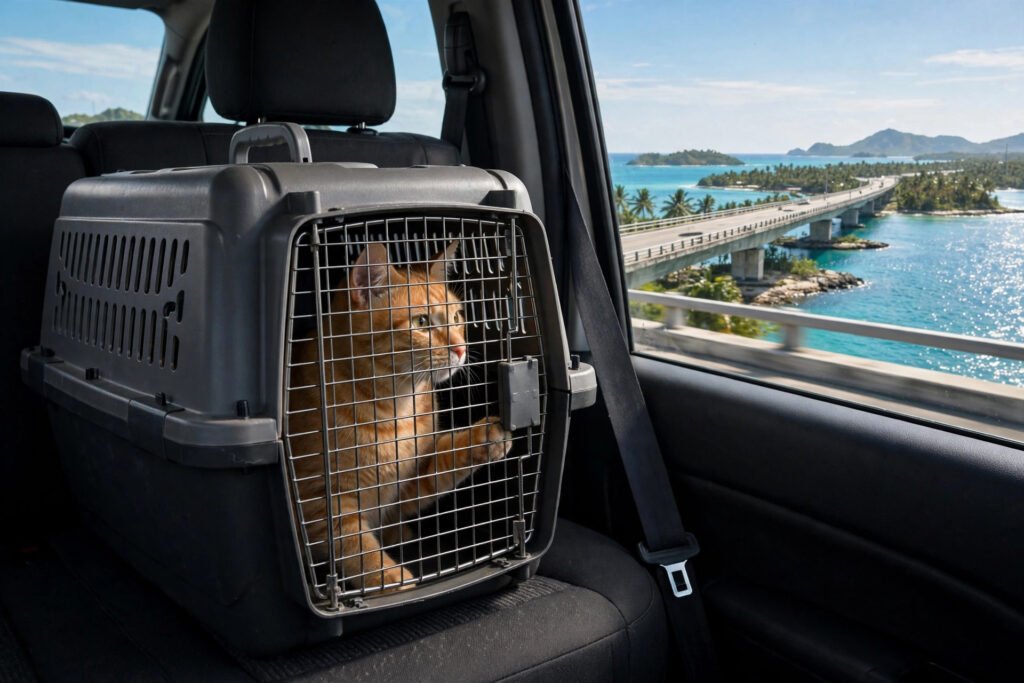
The Overseas Highway unfurls for 113 miles over turquoise water, 42 bridges stitching island to island, and somewhere around mile marker 70 your cat starts yowling like the car is sinking. Driving the Florida Keys with a cat sounds idyllic — windows down, salt air, your co-pilot riding shotgun to Key West. In practice, it’s one of the most demanding pet trips in America: extreme heat, a single two-lane highway, limited emergency vet coverage, and a cat that did not consent to any of this.
Most people get the same handful of things wrong on this drive, and the mistakes range from merely miserable (for the cat) to genuinely dangerous. Here’s what long-distance cat car travel in the Florida Keys actually requires — and the errors to avoid.
Mistake #1: Treating It Like a Dog Road Trip
The biggest error is importing dog-trip logic. Dogs adapt to cars with training; cats are territorial animals whose stress response to unfamiliar environments is hardwired and severe. A dog pants happily at a rest stop. A cat at a rest stop is an escape waiting to happen — and on the Overseas Highway, “escape” can mean bolting into traffic on a bridge with water on both sides.
The rule: the cat rides in a secured carrier, always. Not on a lap, not on a harness in the back seat, not “she’s fine, she just sits there.” A startled cat can wedge under brake pedals, and a loose cat at a rest stop is gone in three seconds. The carrier should be hard-sided (soft carriers collapse in a crash), large enough for the cat to stand and turn, secured with a seatbelt through the handle, and positioned out of direct sun. Line it with a familiar-smelling blanket and a puppy pad underneath in case of accidents. This single decision prevents the majority of Keys cat-travel disasters.
Carrier-train before the trip: leave the carrier open at home for two weeks with treats inside, take short practice drives, and build up. A cat meeting a carrier for the first time on departure morning will scream for the entire Seven Mile Bridge.
Mistake #2: Underestimating the Heat
The Florida Keys are hot ten months a year, and a parked car in the Keys becomes lethal with shocking speed — interior temperatures can climb 20 degrees in 10 minutes even with windows cracked. “Cracked windows” is not ventilation; it’s a myth that kills pets every summer. Never leave a cat in a parked car in the Keys, not for five minutes, not with windows down, not in the shade. Florida law allows good Samaritans and law enforcement to break into vehicles to rescue pets in distress, and you can face animal cruelty charges.
Plan the drive around the heat: travel early morning or evening, keep the AC running cold (cats overheat faster than you think — watch for open-mouth panting, which in cats is a serious distress signal, unlike in dogs), and bring more water than seems reasonable. Freeze a water bottle to put in the carrier — it doubles as a cool surface and a slow-melt water source. For the human side of planning a road trip on a budget, the same principle applies: the cheapest plan that skips safety margins is the most expensive plan when something goes wrong.
Mistake #3: No Litter, No Water, No Plan for Stops
Cats won’t “hold it” like dogs, and they won’t use a rest-stop grass patch either. On a 4-plus-hour Keys drive (Miami to Key West is easily 4 hours without traffic, often 5–6), your cat needs a litter option. The practical setup: a small disposable litter tray on the floor of the back seat or in a larger “travel condo” carrier, offered at each stop with the car doors closed and the cat still contained. Many cats won’t use it while stressed — that’s fine; the option prevents the alternative.
Water matters as much. Offer water at every stop via a spill-proof bowl or syringe; dehydrated cats develop urinary issues fast, and male cats are especially prone to life-threatening urinary blockages when stressed and under-hydrated. Bring the cat’s regular food — dietary changes plus travel stress is a recipe for vomiting and diarrhea — and feed a small meal a few hours before departure rather than right before.
Mistake #4: Skipping the Vet Visit Before Departure
A pre-trip vet check 1–2 weeks before departure is non-negotiable for long-distance cat travel. The vet confirms the cat is fit to travel, updates vaccines (rabies vaccination is legally required in Florida and proof may be requested by lodgings), prescribes anti-anxiety medication if needed (gabapentin, given 2–3 hours before travel, is the current standard for feline travel anxiety — ask your vet, don’t guess the dose), and provides a health certificate if your lodging or any checkpoint requires one.
This is also when you confirm the microchip registration is current — a lost cat in an unfamiliar key is a nightmare scenario, and the chip is the recovery plan. The AVMA’s pet travel guidance covers the documentation checklist, and it’s worth reading before you pack.
Mistake #5: Assuming Every Stop Is Pet-Friendly
The Keys are not uniformly pet-welcoming. Many beaches in the Keys prohibit pets entirely (dogs and cats), state parks have restrictions, and restaurants with outdoor seating vary. Research before you go: which lodgings accept cats (many “pet-friendly” hotels mean dogs only — call and confirm cats specifically), where the emergency vet clinics are (there’s a notable gap in 24-hour emergency coverage on some middle keys, so know the nearest one to your route), and which attractions allow crated pets.
Book cat-friendly lodging in advance — the Keys’ limited hotel inventory fills fast in season, and “we’ll find something” is how you end up sleeping in the car with a yowling cat. Bring Feliway wipes or spray for the carrier and hotel room; the evidence for pheromones is modest but the downside is zero. And keep a recent photo of your cat on your phone plus the microchip number in your notes — the same discipline for keeping pets safe while traveling that applies to any trip, doubled for a bridge highway over open water.
Mistake #6: Free-Roaming the Hotel Room Unprepared
Arriving and opening the carrier in a strange hotel room is mistake number six. Cat-proof the room first: check under beds for gaps (cats wedge into box-spring linings and get stuck), close toilet lids, secure blind cords, check that windows actually latch, and look for housekeeping chemicals under sinks. Set up a “base camp” in the bathroom — litter box, water, food, and the open carrier as a hide — and let the cat decompress there for an hour before exploring.
Keep the “do not disturb” sign on the door for the entire stay. A housekeeper opening the door is the number-one way hotel cats escape, and a lost cat in Key West’s rooster-and-iguana chaos is extremely hard to recover. The ASPCA’s travel safety tips reinforce the same protocol: containment first, exploration second, always.
Conclusion
What most people get wrong about long-distance cat car travel in the Florida Keys is treating it as a scenic drive that happens to include a cat, when it’s really a logistics operation that happens to include scenery. Secure the carrier, respect the heat absolutely, plan litter and water stops, see the vet beforehand, confirm cat-friendly lodgings, and cat-proof every room. Do those six things and the Overseas Highway becomes what it should be: 113 miles of turquoise water with your co-pilot riding safely shotgun.
Frequently Asked Questions
How long can a cat stay in a carrier in the car?
Most cats handle 4–6 hours with stops every 2 hours for water and a litter opportunity. For longer drives, upgrade to a larger travel carrier or “condo” with room for a small litter tray, and never exceed 8 hours without a real break.
Should I sedate my cat for the drive to Key West?
Don’t sedate without veterinary guidance. The modern standard is gabapentin prescribed by your vet, given 2–3 hours before travel — it reduces anxiety without heavy sedation. Discuss it at a pre-trip vet visit 1–2 weeks before departure.
Are cats allowed on Florida Keys beaches?
Most Keys beaches prohibit pets entirely. Check specific beach rules before going, keep cats leashed and contained where allowed, and never leave a cat unattended outdoors — the Keys have traffic, wildlife, and heat hazards.
What if my cat escapes at a rest stop in the Keys?
Stay calm, don’t chase (chasing triggers flight). Sit near the car with the open carrier and familiar-smelling items. Alert rest stop staff immediately. This is why the carrier-always rule and a current microchip matter so much.
Do hotels in the Florida Keys accept cats?
Some do, but many “pet-friendly” properties mean dogs only. Always call ahead and confirm cats specifically, ask about fees and weight limits, and book early — Keys lodging inventory is limited, especially in season.