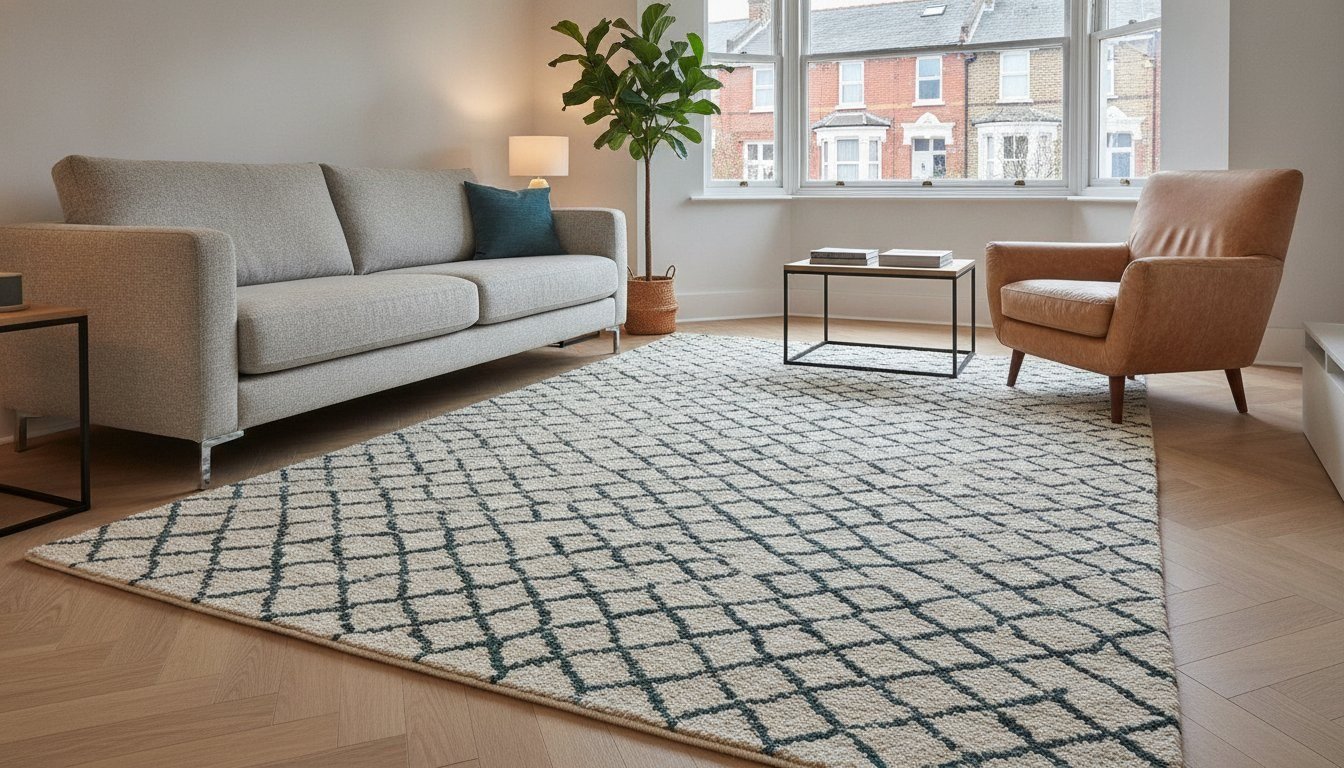
A rug that’s too small makes even a beautiful living room look awkward — like a postage stamp floating in an ocean of floor. It’s the most common decorating mistake I see, and it’s completely avoidable. Rug sizing follows actual rules, not just taste. Here’s how to choose the right size rug for your living room on the first try, without the expensive trial-and-error.
How to Choose the Right Size Rug for Your Living Room
The golden rule: front legs on the rug
In a living room, the rug should be large enough that the front legs of all seating (sofa, chairs) sit on it. This anchors the furniture grouping and defines the conversation area. A rug that floats in the middle, touching nothing, visually shrinks the room and looks like a mistake. When in doubt, go bigger — designers consistently say the number one rug error is going too small.
Standard sizes and when to use them
- 5×8 feet: Works for small living rooms, apartments, or under a loveseat with one chair. This is the minimum for a real seating area — anything smaller belongs in a bedroom or entryway.
- 8×10 feet: The sweet spot for most living rooms. Fits a standard sofa with front legs on, plus two chairs. If you only remember one size, remember this one.
- 9×12 feet: For large living rooms and sectionals. Allows all furniture legs fully on the rug, which looks luxurious and intentional.
- 10×14+ feet: Great rooms and open-plan spaces. At this scale, the rug defines the living zone within a larger area.
The measurement method (do this before buying)
- Arrange your furniture where you want it.
- Measure the seating grouping’s footprint, then add 24-36 inches on each side — that’s your ideal rug size.
- Leave 12-18 inches of bare floor between the rug’s edge and the walls (in small rooms, 8 inches minimum). Wall-to-wall rug looks like carpet; a proper border looks designed.
- Use painter’s tape to outline the rug size on the floor. Live with the outline for a day. This free step prevents 90% of sizing mistakes.
Special layouts
- Sectional sofas: The rug should extend beyond the chaise/sectional’s longest side. Usually means 9×12 minimum — sectionals eat 8x10s for breakfast.
- Open-plan spaces: The rug defines the living area. All living room furniture relates to the rug; dining furniture gets its own rug (or none). Two rugs in one open space is fine — they create zones.
- Fireplace focal point: Center the rug on the fireplace, not the room. Furniture arranges around the fireplace; the rug follows the furniture.
- Small living rooms: Don’t downsize the rug to match a small room — a larger rug actually makes small rooms feel bigger by unifying the space. An 8×10 in a 12×14 room works beautifully.
Beyond Size: What Else Matters
- Pile height and doors: Measure door clearance — thick rugs jam doors. Low-pile or flatweave near doorways.
- Use a rug pad: A $30-$80 felt pad prevents slipping, adds cushioning, extends rug life, and protects floors. Non-negotiable on hard flooring.
- Material and lifestyle: Wool is the gold standard (durable, stain-resistant naturally); synthetics are budget-friendly and washable. With pets or kids, consider washable rugs — pet-friendly flooring strategies apply to rug choices too.
- Pattern scale: Large rooms handle large patterns; small rooms need smaller-scale patterns or solids. A huge pattern in a small room overwhelms; a tiny pattern in a big room looks busy.
Common Mistakes to Avoid
Buying the rug before the furniture (furniture dictates size, not vice versa). Choosing based on the sale price rather than the right size (a cheap wrong-size rug is expensive). Ignoring the pad (the rug slides, bunches, and wears out in half the time). And placing the rug under only the coffee table — the “floating island” look that makes rooms feel disconnected.
Once the rug is right, the room comes together — paint color and rug choice work as a pair, and thick rugs with dense pads double as sound absorbers.
Rug Materials and Construction: What You’re Paying For
Understanding rug construction prevents overpaying. Hand-knotted ($500-$5,000+): the gold standard — each knot tied by hand, lasts decades, appreciates in quality pieces. Worth it for heirloom purchases; overkill for a first apartment. Hand-tufted ($200-$800): punched through a backing with adhesive — looks good, lasts 5-10 years, the sweet spot for most buyers. Machine-made ($80-$400): consistent, affordable, enormous design range. Modern machine-made rugs are excellent — don’t snob them.
Flatweave (kilims, dhurries, $100-$500): no pile, reversible, easy to clean, great for high-traffic and layering. Shag/high-pile: cozy but traps everything and shows footprints — beautiful in low-traffic bedrooms, miserable in dining rooms. Match pile to the room’s reality, not the showroom fantasy.
Material-wise: wool is naturally stain-resistant (lanolin), durable, and feels luxurious — the best long-term value despite higher upfront cost. Synthetics (polypropylene, nylon) are budget-friendly, often washable, and ideal for kids/pets/high-traffic. Cotton is soft and affordable but stains easily and wears faster. Jute/sisal bring natural texture but are rough underfoot and hate moisture — great for living rooms, terrible for kitchens.
The Consumer Reports buying guides test rug durability and stain resistance across price points — worth checking before a major purchase. And remember: the pad matters as much as the rug. A $400 rug on a $60 quality pad outlasts and outperforms a $600 rug on bare floor.
Living Room Rugs: Quick Answers
What size rug for a standard sofa? 8×10 feet is the sweet spot — front legs of the sofa and chairs on the rug. For sectionals, go 9×12.
Is a bigger rug always better? Almost always — the number one rug mistake is going too small. When torn between sizes, choose the larger one.
Do I need a rug pad? Yes, on hard flooring — it prevents slipping, adds cushioning, extends rug life, and protects the floor. $30-$80 well spent.
The Bottom Line
Choose the right size rug by ensuring front furniture legs sit on it, defaulting to 8×10 for standard living rooms (9×12 for sectionals and large rooms), leaving 12-18 inches of floor border, and tape-measuring before buying. Bigger is almost always better than smaller. Get the size right and the rug stops being a decoration and starts being the foundation the whole room is built on.