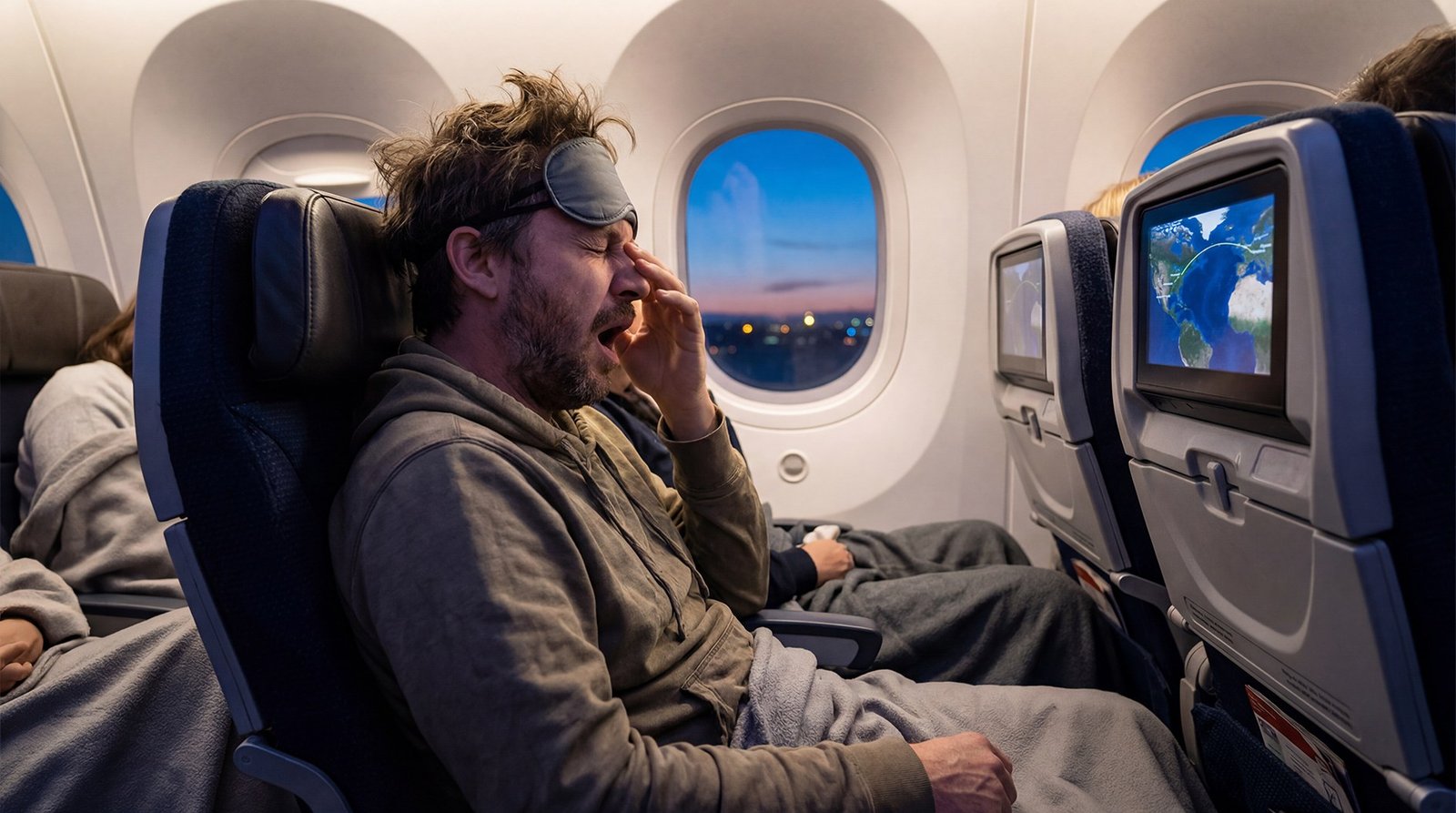
You land at 8 a.m. local time feeling like it’s midnight — because for your body, it is. Your eyes burn, your brain is soup, and the hotel won’t let you check in for six hours. Jet lag is the tax on crossing time zones, and while you can’t avoid it entirely, you can absolutely shrink it from a week of misery to a day of mild fog. Here’s how to deal with jet lag on long flights, based on what sleep scientists actually recommend (not the “drink wine and power through” folk wisdom).
Understand What You’re Fighting
Jet lag isn’t tiredness — it’s circadian misalignment. Your internal clock runs on roughly a 24-hour cycle synced to light, and flying across zones desynchronizes it. Eastward travel (losing hours) is harder than westward because it’s easier for the body to extend the day than compress it. Rule of thumb: recovery takes about one day per time zone crossed eastward, half a day per zone westward. A New York-to-London flight (5 hours east) means ~5 days of natural adjustment — unless you intervene.
The interventions all target the same thing: convincing your body clock it’s already on destination time. Light is the strongest lever, followed by sleep timing, then melatonin and behavior.
Before the Flight: Pre-Shift Your Clock
Starting 2-3 days before departure, shift your sleep schedule toward destination time — 1 hour per day. Flying east? Go to bed an hour earlier each night and get bright light immediately upon waking. Flying west? Stay up an hour later, seek bright light in the evening. Apps like Timeshifter build you a personalized schedule (light exposure, sleep, caffeine, melatonin timing) based on your specific flight — it’s the closest thing to a jet lag cheat code, built on real circadian science.
How Do I Deal With Jet Lag on Long Flights? The In-Flight Protocol
- Set your watch to destination time at boarding. Start thinking in the new time immediately — eat and sleep on destination schedule, not departure schedule.
- Sleep strategically: If you land in the morning, sleep on the plane (eye mask, earplugs, neck pillow — the full kit). If you land in the evening, stay awake and arrive ready for bed. Match your in-flight sleep to what the destination clock wants.
- Hydrate aggressively: Cabin air is drier than the Sahara. Drink water constantly; dehydration amplifies every jet lag symptom. Limit alcohol — it fragments sleep and dehydrates, the exact opposite of what you need.
- Move: Walk the aisle every couple of hours, do seat stretches. It fights stiffness and the circulation risks of long immobility.
- Caffeine with intent: Use it to stay awake when destination time says “daytime,” avoid it when destination time says “night.” Strategic caffeine is a tool; habitual caffeine is just delaying the crash.
For the flight itself, comfort matters more than usual — see our tips for surviving long travel days and sleeping better in transit.
After Landing: Light Is Everything
Get sunlight immediately. This is the single most powerful adjustment tool. Morning sunlight at your destination tells your brain “daytime starts now” and resets melatonin timing. Spend 30+ minutes outside on arrival day — no sunglasses for at least part of it (the light needs to hit your eyes).
Timing matters by direction: flying east, seek morning light and avoid evening light (sunglasses after 4 p.m. help). Flying west, seek evening light. Getting this backwards delays adjustment — light at the wrong time pushes your clock the wrong way.
Melatonin (low dose, timed right): 0.5-1mg taken 30-60 minutes before desired bedtime at the destination helps signal nighttime to your brain. More isn’t better — high doses can cause grogginess and vivid dreams. It’s a timing signal, not a sleeping pill. Check with your doctor if you take other medications.
Stay up until local bedtime on day one. The temptation to nap at 2 p.m. is overwhelming — resist, or cap it at 20-30 minutes. Powering through to a normal local bedtime compresses the adjustment dramatically. One rough day beats four foggy ones.
Eat and Move on Local Time
Meal timing is a secondary clock-setter: eat meals on destination schedule from landing day, even if you’re not hungry. A protein-rich breakfast reinforces “morning.” Exercise helps too — morning workouts advance the clock (good for eastward), evening workouts delay it (good for westward). Even a 20-minute walk counts.
The CDC’s sleep resources cover the fundamentals that make adjustment faster: consistent sleep times, dark cool rooms, and no screens before bed apply doubly when your clock is confused.
What Not to Do
Don’t “power through” on sleeping pills and espresso for days — you’re just masking misalignment while your clock stays lost. Don’t schedule critical meetings for arrival day if avoidable. And don’t stress about perfect adjustment on short trips (2-3 days): for brief stays, it’s often smarter to stay on home time — eat, sleep, and meet on your body’s schedule rather than spending the whole trip adjusting and re-adjusting.
The protocol in brief: pre-shift before flying, sleep strategically en route, get sunlight on landing, stay up till local bedtime, time melatonin right. Do that and jet lag shrinks from a trip-ruining ordeal to a minor inconvenience — leaving you actually able to enjoy the destination you flew so far to see.
Jet Lag With Kids: A Special Challenge
Children get jet lag too, and they can’t rationalize it — they just melt down at odd hours. The good news: kids’ circadian rhythms are more plastic than adults’, so they often adjust faster once you commit to the new schedule. The bad news: the transition days require patience.
Start shifting bedtimes 30-60 minutes toward destination time for 3-4 days before departure — gentler than the adult 1-hour shifts. On the flight, follow the same strategic sleep rules: sleep if landing in the morning, stay awake if landing in the evening. Bring familiar sleep cues (blanket, stuffed animal, white noise app) to make airplane or hotel sleep easier.
On arrival, sunlight is your superpower — get the kids outside in natural light as much as possible on day one. Keep them awake until a reasonable local bedtime (an early one is fine — 7 p.m. local beats a 3 p.m. collapse that wrecks the schedule). Expect 2-3 rough days; plan light activities, keep snacks handy for the witching hours, and don’t schedule the big theme park day for day one. Most families find day three is the turning point — and the kids often adjust a full day before the parents do.
Jet lag is one piece of travel health — our stay-healthy-abroad playbook covers the rest, and making long layovers comfortable helps you arrive human even before the time zones hit.