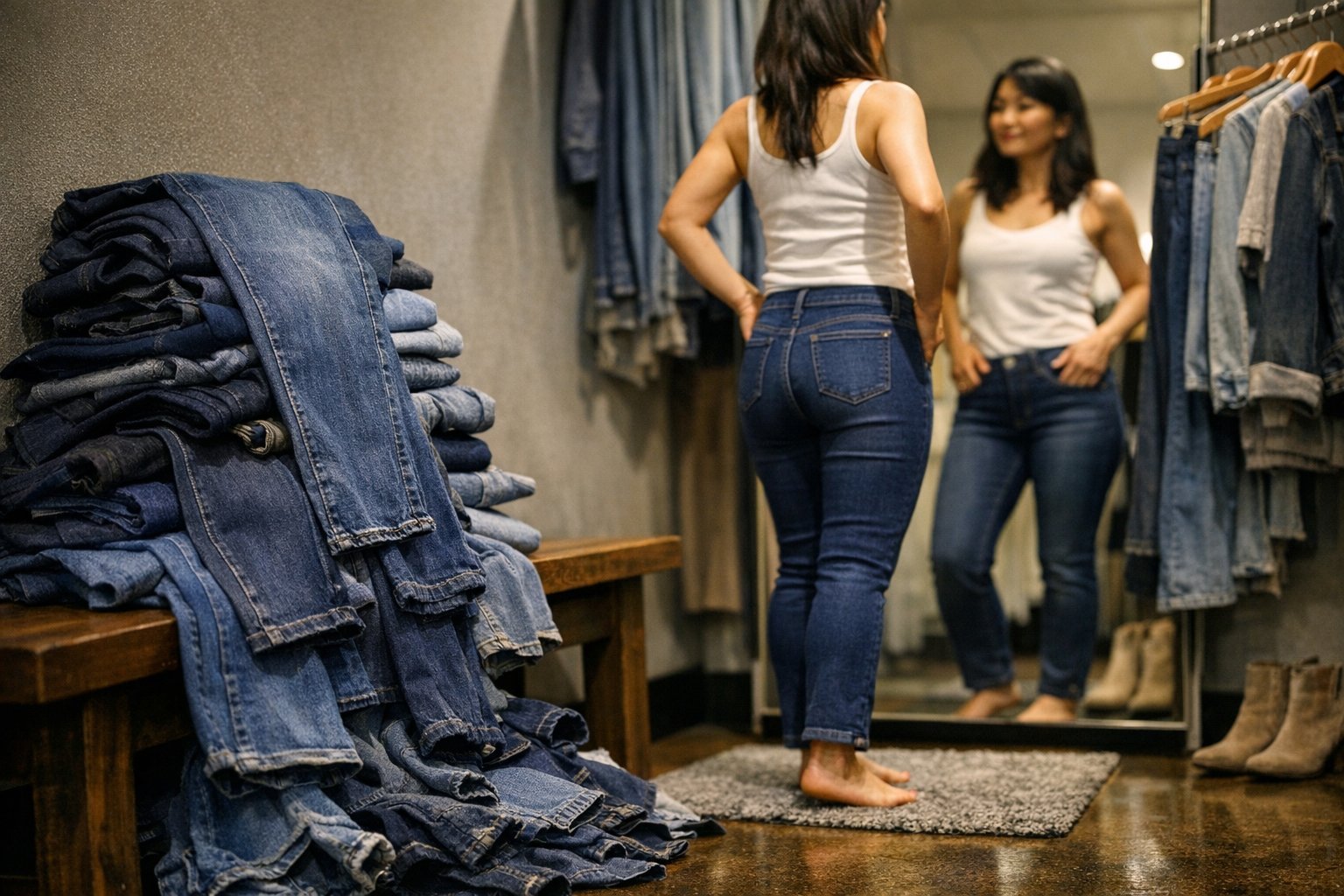
Jeans shopping is a special kind of torment. You try on fifteen pairs, each wrong in a different way — gaping waist, strangling thighs, legs three inches too long, the dreaded back-gap that shows everyone your underwear when you sit. I’ve been there, in fluorescent-lit fitting rooms, questioning all my life choices. Here’s what I eventually learned: finding jeans that fit isn’t about having a “good” body type. It’s about knowing your measurements, understanding jean anatomy, and ignoring the size number entirely.
So how do I find jeans that actually fit my body type? It starts with knowing what to look for — rise, cut, fabric, and fit — matched to your actual shape, not the mannequin’s.
Forget the size tag (seriously)
Jean sizing is fiction. A “size 8” varies by 2+ inches between brands, vanity sizing has inflated everything, and the same brand’s different cuts fit differently. The number is a starting suggestion, nothing more. What matters: your measurements. Measure your natural waist (narrowest point), hips (fullest point), and inseam (crotch to ankle). Write them down in your phone. When shopping online, compare to size charts — not to the size you “usually” wear. This one habit eliminates 80% of fitting-room despair. Our online sizing guide goes deeper on measuring.
How do I find jeans that actually fit my body type? Match the cut to your shape
If you’re curvy (smaller waist, fuller hips/thighs)
Your enemy is the waist gap. Look for: curvy-fit lines (Abercrombie Curve Love, Madewell Curvy, Good American — designed with a smaller waist-to-hip ratio), higher rises that stay put, and stretch denim (2%+ elastane). Avoid rigid low-rise styles. A tailor can also take in a waist for $15–25 — often cheaper than hunting for the unicorn pair.
If you’re straight/athletic (waist and hips similar)
Your challenge is creating shape without swimming in fabric. Look for: mid to high rises, styles with back-pocket detailing and whiskering (visual curves), and slim or straight cuts that follow your lines. Avoid baggy boyfriend cuts unless that’s the intentional aesthetic — they’ll hide rather than flatter.
If you’re petite (5’4″ and under)
Proportion is everything. Look for: petite-specific lines (Madewell Petite, Abercrombie short lengths, Everlane’s cropped lengths), cropped and ankle styles that don’t require hemming, and higher rises that elongate legs. Avoid wide-leg styles in long inseams — they swallow petite frames. Hemming is cheap ($10–15) and transforms almost any pair.
If you’re tall
Your challenge is length. Look for: brands offering 34″+ inseams (Madewell Tall, Long Tall Sally, Abercrombie long), and embrace cropped styles — what’s “cropped” on average heights is full-length on you. Avoid anything that hits at an awkward mid-calf unless intentional.
If you carry weight in the midsection
Comfort and structure matter most. Look for: higher rises (they stay up and smooth rather than digging), stretch denim with good recovery, dark washes (visually streamlined), and straight or relaxed cuts. Avoid low-rise (muffin-top engineering) and super-skinny rigid denim.
The anatomy that matters: rise, fabric, wash
Rise (crotch to waistband) determines where jeans sit — and fit problems are usually rise problems. High rise (10″+) suits most bodies and stays put when you sit; mid rise (9–10″) is the versatile middle; low rise (under 9″) works for few and punishes many. When in doubt, go higher.
Fabric: 100% cotton rigid denim looks amazing but fits precisely one body moment (and stretches unpredictably). 1–2% elastane gives comfort and forgiveness — the sweet spot for most. More than 3% elastane bags out by day’s end. For a capsule wardrobe, one rigid pair (dressier) and one stretch pair (daily) covers everything.
Wash: dark indigo is the most versatile and slimming; medium wash is casual-friendly; light wash is trendy but shows everything. Distressing adds visual noise — fine for casual, terrible for versatility.
The fitting-room checklist
When trying on: sit down (the true test — waist shouldn’t gap or dig), walk (do they stay up without a belt?), check the back (no sagging diaper-butt, no flattening), pinch the waistband (you should fit one finger, not a fist), and squat (thighs shouldn’t scream). New jeans should be slightly snug — denim relaxes with wear. And always try your actual shoe styles: the same jeans look different with sneakers vs. heels, and shoe pairing matters.
When to involve a tailor
A $15 hem or $20 waist alteration turns a $40 pair of jeans into a custom-fit pair. If the hips and thighs fit perfectly but the waist gaps, buy for the hips and tailor the waist — this is what stylish people actually do. Finding a good tailor is a style superpower; our tailor guide explains what to ask for.
Denim deep dive
The modern jeans — from 1870s workwear to today’s dozens of cuts — explains why fit is so complicated: the garment has been reinvented for every body and era. Knowing the anatomy (rise, cut, fabric) cuts through a century of accumulated variation.
The takeaway
Finding jeans that fit your body type means: ignore the size tag and know your measurements, choose rise and cut for your shape (curvy-fit lines, petite/tall ranges, higher rises for most), pick fabric with a touch of stretch, run the sit-walk-squat fitting-room test, and tailor the rest. The perfect pair exists — it’s just hiding behind bad sizing systems and the myth that off-the-rack should fit everybody. It shouldn’t, and that’s what tailors are for.
Breaking in raw denim: is it worth it?
Raw (unwashed) denim is the enthusiast’s rabbit hole: stiff, dark, shrink-to-fit jeans that mold to your body over months, developing personalized fading patterns (“whiskers,” “honeycombs”) that enthusiasts prize like patina on leather. The ritual — wear daily for months without washing, then wash carefully — produces jeans that fit like nothing off the rack. But is it worth it for a normal person? The case for: the fit becomes genuinely custom (the denim stretches exactly where your body needs it), the fading is one-of-a-kind beautiful, quality raw denim (from brands like Naked & Famous, Unbranded, or Japan’s Okayama mills) lasts years, and there’s real satisfaction in the process. The case against: the first weeks are uncomfortable (cardboard-stiff), the no-wash period is socially questionable (freezer “cleaning” is a myth — it doesn’t kill bacteria), quality pairs start around $80–100+, and the time investment is real.
The middle path: “once-washed” or “rinsed” raw denim gives you most of the quality and character without the extreme break-in — the sweet spot for the curious. Or buy quality selvedge in a regular wash and just wear them hard; you’ll get 80% of the experience with 20% of the fuss. My verdict: raw denim is a hobby, not a necessity. If the ritual appeals to you, it’s deeply satisfying. If it sounds like homework, buy good stretch denim that fits today and spend your energy elsewhere. Great jeans don’t require suffering — but for some of us, the suffering is weirdly part of the fun.